If you have more than one debt, you have to decide which one gets your extra money first. The two best-known answers are the debt snowball and the debt avalanche.
Both methods work. The difference is the order you pay things off, and that changes how much interest you pay and how soon you get your first win. Below, we run one realistic example through both methods, month by month.
|
Key takeaways • Snowball: pay the smallest balance first. Avalanche: pay the highest interest rate first. • Both methods pay every minimum, every month. Only the extra money moves. • In our example, avalanche saved $71.28 in interest; snowball cleared the first debt 11 months sooner. • Pick the method you will actually stick with. Sticking with it matters more than the order. |
How the debt snowball works
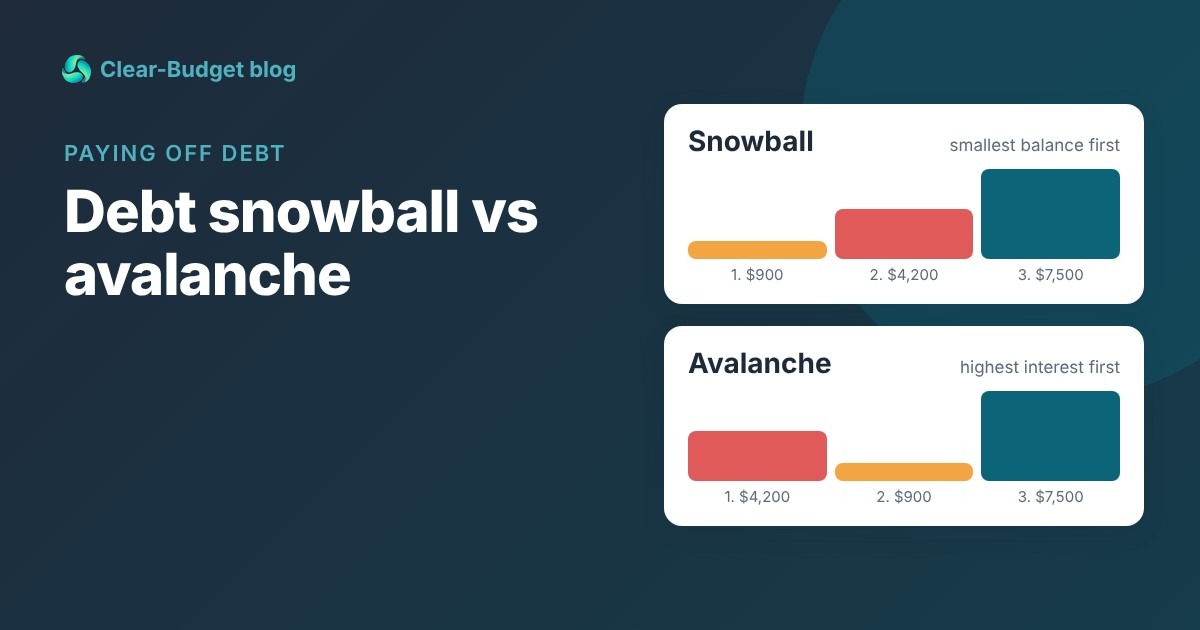
List your debts from the smallest balance to the largest. Pay the minimum on all of them, and put every extra dollar on the smallest one.
When the smallest debt is gone, add its payment to the next one. The payment "snowballs" as each debt disappears.
The appeal is quick wins. Clearing a whole debt early can keep you motivated.
How the debt avalanche works
List your debts from the highest interest rate to the lowest. Pay the minimum on all of them, and put every extra dollar on the highest-rate debt.
When it is paid off, roll its payment to the next-highest rate. Because you attack the most expensive debt first, you pay less interest overall.
The downside is that your first win can take longer if the highest-rate debt is also a big one.
Worked example: Chris has three debts and $600 a month
Chris can put $600 a month toward debt. He owes $12,600 across three debts:
|
Debt |
Balance |
Interest rate (APR) |
Minimum payment |
|
Store card |
$900 |
18.0% |
$30 |
|
Credit card |
$4,200 |
24.9% |
$105 |
|
Car loan |
$7,500 |
7.5% |
$230 |
|
Total |
$12,600 |
|
$365 |
The minimums add up to $365, so Chris has $235 extra each month. The only question is where the extra goes.
• Snowball order: store card ($900), then credit card ($4,200), then car loan ($7,500).
• Avalanche order: credit card (24.9%), then store card (18.0%), then car loan (7.5%).
How we calculated it
We wrote a small script to work through every month. Each month, interest is added to each balance (balance × APR ÷ 12, rounded to the cent). Then every minimum is paid, and the rest of the $600 goes to the target debt.
When a debt is paid off, its money rolls to the next debt in line. Real lenders may calculate interest daily, so your own numbers will differ slightly.
Balances month by month
|
Month |
Snowball: store |
Snowball: credit |
Snowball: car |
Avalanche: store |
Avalanche: credit |
Avalanche: car |
|
Start |
$900.00 |
$4,200.00 |
$7,500.00 |
$900.00 |
$4,200.00 |
$7,500.00 |
|
1 |
$648.50 |
$4,182.15 |
$7,316.88 |
$883.50 |
$3,947.15 |
$7,316.88 |
|
2 |
$393.23 |
$4,163.93 |
$7,132.61 |
$866.75 |
$3,689.05 |
$7,132.61 |
|
3 |
$134.13 |
$4,145.33 |
$6,947.19 |
$849.75 |
$3,425.60 |
$6,947.19 |
|
6 |
$0 |
$3,417.43 |
$6,383.94 |
$797.21 |
$2,601.99 |
$6,383.94 |
|
12 |
$0 |
$1,527.19 |
$5,225.36 |
$684.81 |
$794.42 |
$5,225.36 |
|
18 |
$0 |
$0 |
$3,415.15 |
$0 |
$0 |
$3,346.48 |
|
24 |
$0 |
$0 |
$0 |
$0 |
$0 |
$0 |
Balances at the end of each month, after interest and payments. Selected months shown.
How the payment rolls
The total stays at $600 every month. What changes is how that $600 is split.
|
Period |
Store card |
Credit card |
Car loan |
|
Snowball, months 1–4 |
$265 |
$105 |
$230 |
|
Snowball, months 5–17 |
Paid off |
$370 |
$230 |
|
Snowball, months 18–24 |
Paid off |
Paid off |
$600 |
|
Avalanche, months 1–15 |
$30 |
$340 |
$230 |
|
Avalanche, months 16–17 |
$370 |
Paid off |
$230 |
|
Avalanche, months 18–24 |
Paid off |
Paid off |
$600 |
In the month a debt is paid off, the leftover amount goes to the next debt, so that month’s split is slightly different. The final car payment in month 24 is smaller than $600.
Notice how the snowball grows. The store card’s $265 joins the credit card’s $105 to make $370. When the credit card is gone, all $600 hits the car loan.
The results
|
|
Snowball |
Avalanche |
|
First debt paid off |
Store card, month 4 |
Credit card, month 15 |
|
Second debt paid off |
Credit card, month 17 |
Store card, month 17 |
|
Debt-free |
Month 24 |
Month 24 |
|
Total interest paid |
$1,688.51 |
$1,617.23 |
|
Total paid |
$14,288.51 |
$14,217.23 |

Same three debts, same $600 a month. Only the order changes.
Avalanche saved Chris $71.28 in interest. Snowball gave him his first paid-off debt in month 4 instead of month 15. Both made him debt-free in month 24.
Why so close? The car loan is the biggest debt and has the lowest rate in both orders, so it finishes last either way. The order only changes the first two debts, and the store card is small.
When each method wins
Avalanche tends to win on money when
• Your highest-rate debt is also large, so it builds a lot of interest.
• The gap between your interest rates is wide, like 29% vs 6%.
• You are motivated by numbers and don’t need early wins to keep going.
Snowball tends to win on motivation when
• You have one or two small debts you could clear in a few months.
• You have tried and given up before. An early win can keep you going.
• Your interest rates are fairly close, so the order costs little extra.
In Chris’s case, the cost of choosing snowball was about $3 a month over two years. If that early win in month 4 keeps him on track, it is money well spent.
|
A middle path: if one tiny debt can be cleared in a month or two, pay it off first for the quick win. Then switch to avalanche for the rest. |
Mistakes that slow down either method
• Missing a minimum payment. Late fees and penalty rates can wipe out any savings from the method you chose. Set up every minimum first.
• No emergency fund. Without a small cushion, the next car repair goes on a card. Our emergency fund guide explains how to start small.
• Not rolling the payment over. When a debt is gone, its payment must move to the next one, or the method stops working.
• Adding new debt. Paying down one card while charging another keeps you in place. Common budgeting mistakes covers how to avoid this.
What about 0% balance transfers or consolidation?
Some people move high-rate debt to a 0% balance transfer card or a lower-rate loan. That changes the interest rates in your list, so it can change your avalanche order.
Read the fees and the date the promotional rate ends before you decide. Then put the new rates into your list and run both methods again.
Finding the extra money
Either method only works if there is extra money to send. Chris found his $235 by looking at each paycheck, not just the month.
If you are paid every two weeks, budgeting by paycheck makes it easier to see where an extra $100 can come from. A zero-based budget helps too, because every dollar gets a job, including debt.
Try it with your own debts
The free debt payoff calculator lets you enter your own balances, rates and monthly amount, so you can compare payoff dates for your situation.
Inside Clear-Budget, each debt gets its own bucket with its balance and interest rate. A payoff-date slider shows how a bigger payment moves your debt-free date. It is free, and you never link a bank.
FAQ
Is the debt snowball or avalanche better?
Avalanche usually costs less interest. Snowball usually gives you a paid-off debt sooner. In our example, avalanche saved $71.28 and snowball cleared the first debt 11 months earlier.
Do I still pay minimums on the other debts?
Yes. Both methods pay every minimum every month. Only the extra money goes to the target debt.
Should I include my mortgage or car loan?
You can include any debt, but low-rate loans usually end up last in both orders. Many people focus on cards and personal loans first.
Can I switch methods partway through?
Yes. Switching costs nothing. Many people start with snowball for a quick win, then switch to avalanche.
This article is for general information only and is not financial advice.