|
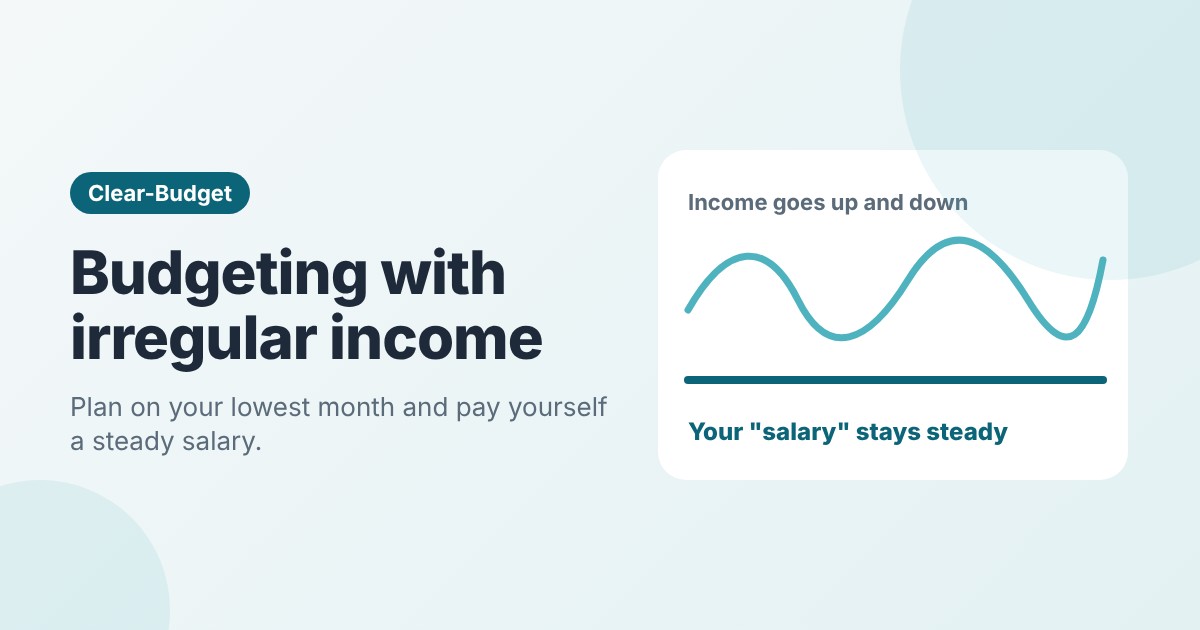
Key takeaways • Build your budget on your lowest typical month, not your average or your best. • Send all income to a holding account first, then pay yourself a fixed amount on set dates. • Good months fill a buffer. Slow months draw from it. Your budget stays the same. • Once the buffer holds about one month of salary, extra income can go to goals. |
Most budgeting advice assumes the same paycheck lands every two weeks. If you work for tips, drive for apps, freelance or earn commission, that advice can feel useless.
The good news: you can still budget. You just need a system that turns uneven income into a steady amount. This guide shows you how.
Why irregular income is hard to budget
The problem isn't the total. Many people with irregular income earn plenty over a year. The problem is timing.
In a good month, it is easy to spend more because the money is there. Then a slow month comes and rent is due. Without a plan, the good months don't cover the bad ones.
The method below fixes that with three parts: a baseline budget, a holding account, and a steady salary you pay yourself.
Step 1: Find your lowest typical month
Look back at your take-home pay for the last 6 to 12 months. Write down what actually landed in your account each month after taxes and fees.
Now find the lowest typical month. That means a normal slow month, not a freak month when you were sick for three weeks. This number is your planning income.
|
Why not the average? If you budget on your average, every below-average month leaves you short. Budgeting on a low month means most months will come in above plan, and the extra builds your safety net. |
Step 2: Build a baseline budget on that number
Your baseline budget covers what you must pay to live, plus a little for savings and fun. It has to fit inside your lowest typical month.
Start with the bills you can't skip: rent, utilities, phone, insurance, transportation, groceries and minimum debt payments. If you need help listing these, see how to create your first budget.
If the essentials don't fit inside your low month, that is important to know now. It means you need to cut a cost or find steadier income, not hope for good months.
Step 3: Open a holding account
A holding account is a separate savings account where all your income goes first. Tips, client payments, app payouts: everything lands here.
You don't spend from this account. Its only job is to collect income and pay you a salary. This one step stops a big week from turning into a big weekend.
Ideally this account sits at a different bank from your checking. A little friction makes it harder to dip in on impulse.
Step 4: Pay yourself a steady salary
Pick a salary equal to your baseline budget. Then pick paydays, like the 1st and the 15th. On each payday, move half the salary from the holding account to checking.
Now your budget looks just like someone with a regular job. Same amount, same dates, every month. You can plan bills around those dates the way our guide to budgeting by paycheck describes.

All income lands in the holding account first. The budget only sees the steady salary.
Worked example: Marcus, a restaurant server
Marcus works as a server. His take-home pay, including tips, changes a lot from month to month. Here are his last six months.

Marcus's income ranged from $2,700 to $3,800. His salary is set at his lowest month.
His average is $3,250. His lowest typical month is August at $2,700. So Marcus sets his salary at $2,700 a month, paid as $1,350 on the 1st and $1,350 on the 15th.
Marcus's baseline budget
|
Category |
Monthly amount |
|
Rent |
$1,200 |
|
Utilities |
$150 |
|
Phone |
$50 |
|
Car payment and insurance |
$330 |
|
Gas |
$150 |
|
Groceries |
$400 |
|
Credit card minimum |
$120 |
|
Personal and fun |
$150 |
|
Emergency fund |
$150 |
|
Total |
$2,700 |
How a good month and a slow month play out
In June, Marcus brings home $3,800. He still only pays himself $2,700. The extra $1,100 stays in the holding account.
In August, he brings home $2,700. That exactly covers his salary, so the buffer doesn't move. If a month came in at $2,400, the buffer would cover the missing $300.
Over these six months, Marcus earned $19,500 and paid himself $16,200. That leaves $3,300 in the holding account, which is more than a full month of salary.
How big should the buffer be?
Aim to keep at least one month of salary in the holding account. For Marcus, that is $2,700. With that much in place, even a very slow month won't change his budget.
Once the buffer is full, Marcus can choose what to do with the extra. He might:
• Grow a separate emergency fund for bigger shocks
• Pay down debt faster. Our debt payoff calculator shows how much sooner
• Fund sinking funds for yearly costs
• Give himself a raise if his low months have clearly gone up
Until the buffer is full, resist the raise. The buffer is what makes the whole system calm.
Extra tips for freelancers
Freelancers have one more thing to plan for: taxes. If no one withholds tax from your pay, you need to set it aside yourself.
The IRS says that if you are in business for yourself, you generally need to make estimated tax payments, and the year is split into four payment periods. A tax professional can help you work out the right amount.
• Set taxes aside first. When a client pays, move your tax share to its own savings account before anything goes to the holding account.
• Base your salary on income after tax. Your "lowest month" should be the amount left after setting tax aside.
• Watch for slow seasons. If you always have a quiet January, build a bigger buffer before it.
If you are just starting out
You may not have a buffer yet. That is normal. For the first few months, try this:
1. Build your baseline budget on your lowest typical month.
2. Spend only on the baseline, even in good weeks.
3. Let everything above it pile up in the holding account.
4. Switch to a fixed salary once you have one month saved.
It takes discipline at first. For habits that help, see 10 realistic tips to stick to a budget.
Mistakes to watch for
• Spending straight from the holding account. It should only ever pay your salary.
• Raising your salary after one good month. Wait until the buffer is full and the trend holds.
• Forgetting yearly costs. Slow months are harder when a yearly bill lands at the same time. Plan for them ahead.
How Clear-Budget helps with irregular income
Clear-Budget lets you build a budget over any dates, so you can plan from salary day to salary day or by the month. Add your two salary payments as repeating income items, then add your bills with their due dates.
The running balance shows where you stand after each item. You can also set up a savings goal bucket for your buffer and see it grow each time you have a good month.
Sign up free with Google or email. No bank login needed.
Frequently asked questions
What counts as my lowest typical month?
Look at 6 to 12 months of take-home pay. Ignore one-off disasters, but include normal slow seasons. The lowest normal month is your planning number.
What if my low month doesn't cover my bills?
Then the budget is telling you something important. Look for costs to cut, add a steady side income, or plan to cover the gap from savings while you adjust.
Do I need a separate bank account for the holding account?
It helps a lot. Mixing it with checking makes it easy to spend your buffer by accident. A free savings account is enough.
Can I give myself a raise?
Yes, once your buffer holds at least one month of salary and your low months have clearly gone up. Raise it a little at a time.
This article is for general education and is not financial advice. Your situation may be different, so adjust the numbers to fit your own budget.