|
Key takeaways • An overdraft is usually a timing problem, not a spending problem. • List your money in and out by date to find your lowest balance day. • Move a due date or a payment so the low day stays above zero. • Keep a small cushion in checking that you treat as $0. • Know how your bank handles overdrafts, and change the settings if you want declines instead of fees. |
An overdraft fee can feel unfair. You got paid. Your bills add up to less than your paychecks. And yet the bank still charged you.
That's because your bank doesn't look at your month. It looks at one day at a time. If one bill clears on the wrong day, you can be short even in a month where you have money left over.
The good news: timing problems are easy to see once you know where to look.
What an overdraft actually is
An overdraft happens when a payment goes through for more than is in your account. The bank covers the gap, then charges you a fee for doing it. Some banks also charge a fee when they decline a payment for not enough money.
Fees differ from bank to bank, and some banks have dropped them. Look up your own bank's fee schedule and write the amount down. Seeing the real number makes it easier to take a few minutes to prevent it.
Why it happens even when you have enough
Most overdrafts come from one of these:
• A bill lands right before payday. The money is coming, just not yet.
• Autopay you forgot about. A yearly renewal or a subscription you stopped using.
• Pending purchases. Your balance looked fine, but some card purchases hadn't cleared yet.
• Small purchases after a big bill. Rent clears, then a few coffees and a gas fill-up push you under.
All four are about when money moves. So the fix starts with a calendar, not a cut.
Step 1: Write down every money move by date
List everything that goes in and out of your checking account for the next month, in date order. Include paychecks, bills, autopays, and a planned amount for groceries and gas.
Then keep a running balance. Start with what's in the account today, and add or subtract each line as you go down.
Here is Marcus. He is paid $1,450 on the 1st and the 15th. He has $60 in checking on October 31.
|
Date |
Item |
Amount |
Balance |
|
Nov 1 |
Paycheck |
+$1,450 |
$1,510 |
|
Nov 1 |
Rent |
−$1,100 |
$410 |
|
Nov 4 |
Car payment |
−$285 |
$125 |
|
Nov 7 |
Groceries |
−$95 |
$30 |
|
Nov 10 |
Gas |
−$40 |
−$10 |
|
Nov 12 |
Phone (autopay) |
−$70 |
−$80 |
|
Nov 15 |
Paycheck |
+$1,450 |
$1,370 |
Marcus's month isn't the problem. Over the full month, he brings in more than he spends. But from November 10 to 14, he is below zero. That's two payments that could each bring a fee.
Step 2: Find your lowest balance day
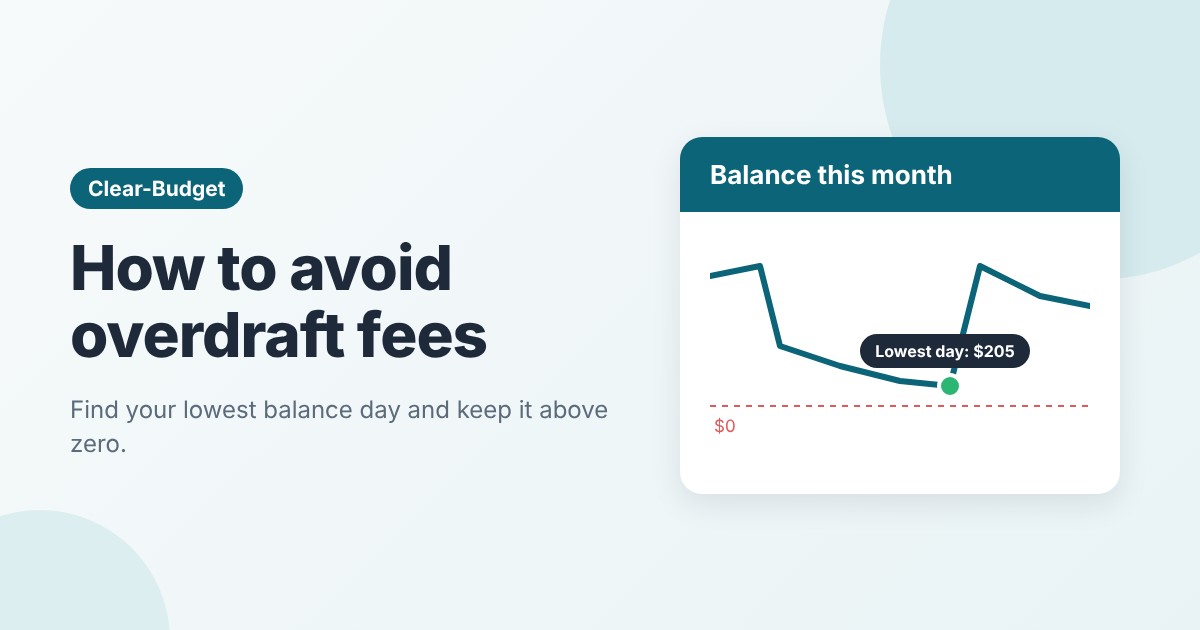
Look down the balance column and find the smallest number. That's your lowest balance day. For Marcus, it's November 12, at −$80.
This one number tells you more than your monthly total. If your lowest balance day is above zero, you won't overdraft on planned bills. If it's below zero, you know exactly which dates to fix.
For most people, the low day falls just before payday. Our post on how much you can spend until payday goes deeper on this idea.
Step 3: Move the bill, not the paycheck
You can't change when you get paid. But you can often change when a bill is due. Many lenders, card companies and phone and utility companies will move a due date if you ask.
Marcus calls his car lender and moves his payment from the 4th to the 18th. Now it's paid from his second paycheck instead of his first.

Moving one payment lifts Marcus's lowest point from −$80 to $205.
Same bills. Same paychecks. His lowest balance is now $205 on November 12, and he never goes below zero.
For a full walk-through on lining up bills with paydays, see how to never miss a bill.
Step 4: Keep a cushion you treat as $0
Even a good plan can be off by a few dollars. A gas fill-up costs more than you thought. A refund takes a week. A cushion handles those small surprises.
Pick an amount, like $100 or $200, and leave it in checking. Then pretend it isn't there. When you look at your balance, subtract the cushion first.
You can build it slowly. Even $20 a paycheck adds up to $100 in five paychecks. Once it's there, it's not for spending, only for timing slips. A bigger safety net belongs in an emergency fund.
Step 5: Check your overdraft settings
Banks handle overdrafts in different ways, and you often get a choice. Spend ten minutes in your bank's app or on the phone and ask:
1. Do I have overdraft coverage turned on for debit card and ATM purchases? In the US, banks need your permission to charge an overdraft fee on these. If you said yes once, you can usually change it. Then a purchase that would overdraw your account is declined instead.
2. Can I link a savings account as backup? Some banks move money from savings to cover a shortfall, sometimes for a smaller fee or none.
3. Do you offer low-balance alerts? A text when your balance drops under a number you choose is a cheap early warning.
4. Will you waive a fee? If you rarely overdraft, ask. Many banks will refund a fee once, especially if you call soon after.
There's no single right setup. If a declined card at the store is better for you than a fee, turn coverage off. If an important payment bouncing would be worse, keep it and lean on your cushion.
Step 6: Watch the next seven days
Once a week, look at what's coming out in the next seven days and compare it with your balance. Ten minutes on a Sunday is enough.
This habit catches the things a monthly plan misses: a renewal you forgot, a bill that changed, a purchase still pending. Our guide on how to stick to a budget has more ideas for making this check stick.
What to do if you overdraft anyway
It happens. Here's what to do quickly:
1. Move money in as soon as you can, so more payments don't add more fees.
2. Pause anything flexible, like shopping or eating out, until you're back above zero.
3. Call your bank and ask for the fee to be waived.
4. Look at what caused it, and fix that date on your list so it doesn't repeat.
How Clear-Budget can help
Clear-Budget is built around a running balance. Each item has a date, and the balance updates as you add bills and paychecks. The app shows a Safe to spend number, which is the lowest your balance gets in the budget, and the day that low point happens.
When you're thinking about moving a bill, you can make a copy of your budget, try the change, and see the new low point before you call anyone. It's free, it works on your phone and the web, and you never link your bank.
FAQ
What's the difference between an overdraft and NSF?
An overdraft means the bank paid the charge and your balance went negative. NSF ("non-sufficient funds") means the bank declined it. Some banks charge for one, both, or neither, so check your bank's fee list.
Do overdrafts hurt my credit score?
An overdraft itself usually isn't reported to the credit bureaus. But if a negative balance goes unpaid for a long time, the bank can close the account and send it to collections, and that can hurt. Bring the balance back above zero quickly.
How big should my checking cushion be?
Start small. Enough to cover your largest regular grocery or gas trip is a good first goal. Later, you might aim for about one week of spending.
Will a budget really stop overdrafts?
A monthly total won't. A dated list with a running balance will, because it shows you the exact day you'd go short, before it happens.
This article is for general information only and is not financial advice.