|
Key takeaways • Put every bill on one calendar with its due date and amount. • Match each bill to the paycheck that will pay it. • If one paycheck carries too much, ask a lender to move a due date. • Autopay helps, but only if the money is there. Check it often. • If you miss one, pay it fast and call the company. It is always worth asking for help. |
Missing a bill rarely happens because you don't care. It happens because there are a dozen due dates, they are spread across the month, and life is busy.
The fix is a simple system. You set it up once, then spend a few minutes a week keeping it current.
Why bills get missed
Before building the system, it helps to know what usually goes wrong:
• Timing. The bill is due before the paycheck that should cover it arrives.
• Forgetting. Bills that come once a year or every few months slip your mind.
• Too many places. Some bills come by mail, some by email, some only in an app.
• Autopay surprises. Autopay runs, but the account is short that day.
A bill calendar handles all four.
Step 1: Make a list of every bill
Go through two or three months of bank and card statements. Write down every bill you find. For each one, note:
• The name of the bill
• The amount (or a typical amount if it changes)
• The due date
• How you pay it: autopay, online, by mail
Don't forget the rare ones: car registration, yearly subscriptions, insurance paid every six months. Those are best handled with sinking funds.
Step 2: Build a bill calendar
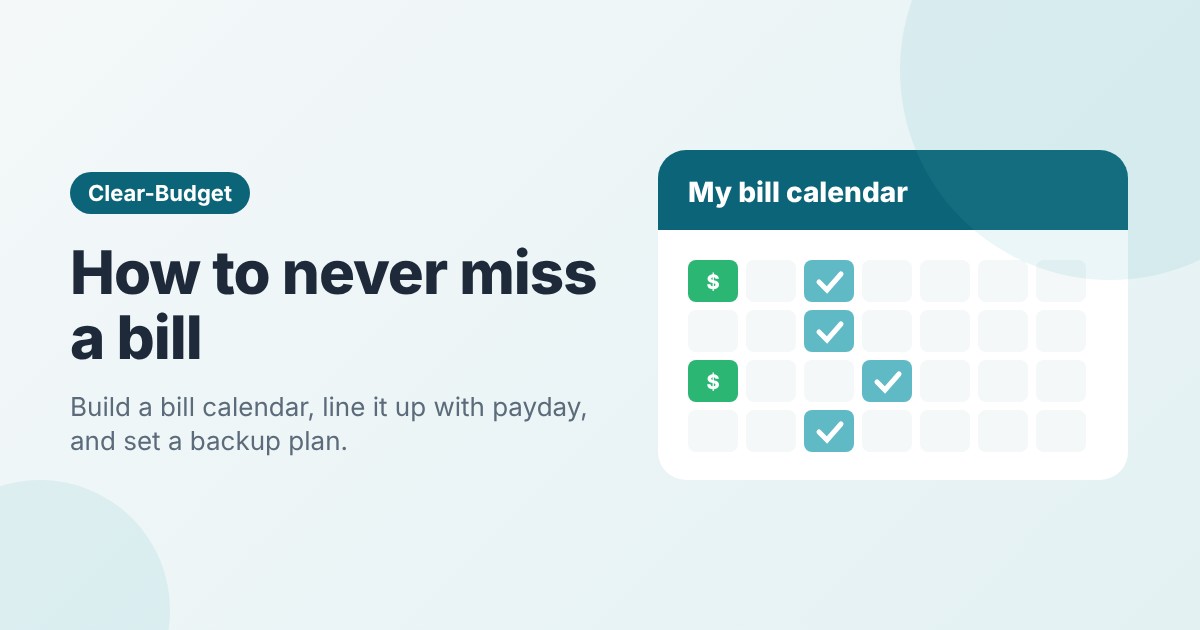
Put every bill on one calendar for the month. Then add your paydays. Seeing them side by side makes timing problems jump out.
Here is what that looks like for Chris. He is paid $1,700 on the 1st and the 15th.

Chris's bill calendar. Most of his big bills fall right after the 1st.
You can use a paper calendar, a phone calendar, or a budgeting app. The tool matters less than keeping everything in one place.
Step 3: Match each bill to a paycheck
Now assign each bill to the paycheck that will pay it. A simple rule: a bill is paid by the last paycheck that lands before its due date.
|
Bill |
Due |
Amount |
Paid from |
|
Rent |
1st |
$1,250 |
1st paycheck |
|
Car loan |
5th |
$310 |
1st paycheck |
|
Phone |
12th |
$65 |
1st paycheck |
|
Electric |
18th |
$110 |
15th paycheck |
|
Credit card |
22nd |
$150 |
15th paycheck |
|
Car insurance |
27th |
$140 |
15th paycheck |
|
Internet |
28th |
$60 |
15th paycheck |
For Chris, the 1st paycheck has to cover $1,625 of bills. That leaves just $75 for two weeks of groceries and gas. The 15th paycheck only covers $460, leaving $1,240.
The total is fine. The timing is the problem.
If you are paid every two weeks instead, the same idea applies. Our guide to budgeting on a biweekly paycheck shows how.
Step 4: Ask to move a due date
Here is a tip worth knowing: you can often ask a lender or company to change your due date. Credit card companies, car lenders, phone and utility companies sometimes allow it. Call them or look in your account settings.
Chris calls his car lender and moves his payment from the 5th to the 20th. Now the car loan comes out of the 15th paycheck instead.

One phone call moved $310 from the tight paycheck to the roomy one.
After the change, the 1st paycheck covers $1,315 and leaves $385. The 15th covers $770 and leaves $930. Same bills, much less stress.
|
Tip: When you ask, have your paydays in front of you. Ask for a date a few days after a payday, not on the same day. That gives the deposit time to clear. |
Step 5: Use autopay wisely
Autopay is a great tool, but it is not a full solution. Here are the trade-offs.
|
Autopay pros |
Autopay cons |
|
You can't forget to pay |
It runs even if your account is short |
|
Saves time every month |
Easy to stop paying attention to the bill |
|
Some lenders offer a small discount for it |
Errors or price increases can slip by |
|
Good for fixed bills like rent or loans |
Harder to control timing when money is tight |
A good middle ground:
• Autopay the minimum on credit cards so you are never late, then pay extra by hand.
• Autopay fixed bills like loans and insurance, where the amount doesn't change.
• Pay variable bills by hand, like utilities, so you see the amount each month.
• Keep a small cushion in checking so an autopay never bounces.
Step 6: Set reminders
Even with autopay, set a reminder a few days before each due date. It is a chance to check the money is there and the amount looks right.
Calendar alerts on your phone work fine. Some people prefer a weekly "bill check" every Sunday: open the budget, look at what is due in the next seven days, and mark what got paid.
How Clear-Budget keeps bills in view
In Clear-Budget, every bill is an item with a due date and an amount. Add your paychecks as income items. Bills can repeat weekly, every two weeks or monthly, so you only enter them once.

Each item has a date, a paid toggle and a running balance, so you can see what is left after every bill.
The running balance shows what will be left after each item, so a tight spot like Chris's $75 is easy to spot. When a bill goes out, swipe to mark it paid. Bill reminders on your phone are coming soon.
If you want to see what is left in each paycheck after bills, try the free paycheck budget calculator.
What to do if you miss a bill
It happens. What you do next matters more than the slip itself.
1. Pay it as soon as you can. Even a few days can make a difference to fees.
2. Call the company. Explain what happened and ask if they will waive the late fee. It is always worth asking.
3. Ask about a payment plan if you can't pay it all right away.
4. Find the cause. Was it timing, forgetting, or not enough money? Fix that part of the system.
Paying fast matters for your credit too. The Consumer Financial Protection Bureau says credit reporting companies can generally report negative information for seven years, so it is worth acting quickly and asking the company how it reports late payments.
If missed bills keep happening because money runs out, the issue may be the budget itself. Our list of common budgeting mistakes is a good place to look.
Keep the system running
A bill calendar only works if it stays up to date. Each time a new bill starts or an amount changes, update it right away. Once a year, go through your statements again and look for anything new.
It also helps to keep a small cushion in checking, even $100 to $200. That way a bill that is a little higher than usual doesn't cause a problem.
Your 15-minute bill setup
List your bills. Put them on a calendar with your paydays.
Match each bill to a paycheck. Move one due date if needed.
Then create a free Clear-Budget account and add your bills with their due dates. No bank login, ever.
Frequently asked questions
Can I change my credit card due date?
Often, yes. Card companies often let you choose a new due date by phone or in your account settings. It doesn't hurt to ask.
Is autopay a good idea?
Autopay is great for fixed bills and credit card minimums. Just keep a cushion in checking and review your bills each month so nothing slips by.
What should I do right after missing a bill?
Pay it as soon as you can, then call the company. Ask if they will waive the late fee, and ask how they report late payments.
How do I keep track of bills that come once a year?
Add them to your bill calendar on the right month and save for them ahead of time with a sinking fund.
This article is for general education and is not financial advice. Your situation may be different, so adjust the numbers to fit your own budget.