If it feels like your money is not stretching as far as it used to, you are not imagining it.
Over the past several years, many households have seen costs rise in nearly every major category: gas, groceries, utilities, housing, insurance and transportation. Even people with a solid budget are finding they need to make changes.
You can’t control inflation. You can control how you respond to it. This guide covers why prices keep rising, how that hits your budget, practical ways to ease the pressure, and how to prepare for future increases.
|
Key takeaways • Update your budget numbers to match today’s prices. An old $400 grocery line won’t work if you now spend $550. • Trim flexible categories first (dining out, delivery, subscriptions) to pay for the essentials that went up. • Check in weekly while prices are moving, not just once a month. • Build a small buffer and keep adding to emergency savings, because emergencies cost more too. |
What is inflation?
Inflation is the gradual rise in the cost of goods and services over time. When it rises, your purchasing power drops, everyday expenses cost more, and your paycheck covers less than it used to.
The government tracks this with the Consumer Price Index (CPI). The latest CPI release from the Bureau of Labor Statistics shows prices were 3.4% higher in August 2026 than a year earlier. Energy was the big driver, up 16.3%, with gasoline up 27.4%.

Source: U.S. Bureau of Labor Statistics, CPI news release, September 11, 2026.
For many households, inflation is no longer just an economic headline. It shows up at the pump and in the grocery line every week.
Why gas prices affect more than your fuel budget
Gas is usually the first price people notice, because the jump is instant and posted on a big sign. The U.S. Energy Information Administration put the national average for regular gas at about $4.35 a gallon in early October 2026. That is roughly $1.23 more than a year earlier.
Higher fuel prices also ripple through the rest of your budget. When fuel costs rise:
• Shipping costs increase
• Grocery transportation costs rise
• Delivery services get more expensive
• Airline tickets often go up
• Businesses pass higher costs on to customers
Real-life gas budget example
Imagine a fill-up that used to cost $45 now costs $70. If you fill up once a week, that is $25 more each week.
|
Weekly fill-up |
Per month |
Per year |
|
Before: $45 |
~$195 |
$2,340 |
|
After: $70 |
~$303 |
$3,640 |
|
Extra cost |
~$108 |
$1,300 |
Monthly figures use 52 weeks ÷ 12 months, about 4.33 fill-ups a month.
That single category alone can knock a stable budget off balance.
Practical ways to cut transportation costs
• Combine trips. Plan errands into one route and avoid repeated short trips. Small cuts in driving add up.
• Rethink convenience habits. Delivery apps cost more when fuel is expensive. Using them a little less can save real money.
• Delay non-essential travel. Fewer optional trips and weekend drives help offset higher fuel costs for now.
Why grocery bills feel so much higher
Grocery inflation has cooled compared with gas. BLS data shows food at home up 2.2% over the year to August 2026. Food away from home rose faster, at 3.4%, so takeout and restaurants are pulling further ahead of cooking at home.
The bigger issue is that the increases stack. A small rise on top of several years of rises means your cart costs much more than it did not long ago.
Groceries also aren’t optional. You can’t stop buying food, which is why grocery inflation hits families, single-income households and people on tight budgets hardest. Even if your habits stay the same, your total can climb.
Ways to lower grocery spending without feeling miserable
Budgeting during inflation should not feel like punishment. The goal is less waste and more intention, not perfection.
• Plan meals before you shop. It cuts impulse buys, food waste and last-minute takeout. Even planning three dinners a week helps.
• Watch “convenience inflation.” Delivery meals, single-serve snacks, pre-cut produce and convenience-store stops often rise faster than basic ingredients.
• Try store brands. Many are very similar to name brands for less money. Swapping 5 to 10 regular items adds up.
• Cut food waste. Freeze leftovers, use older ingredients first, and shop your pantry before buying more.
Your old budget numbers may no longer work
One of the biggest mistakes during inflation is refusing to update your categories. If your grocery line says $400 but you really spend $550, your budget is fiction. Fiction budgets are discouraging, and people quit them.
Budgets should adapt to reality. Here is what that looks like.
Worked example: Jordan updates a $3,600 budget
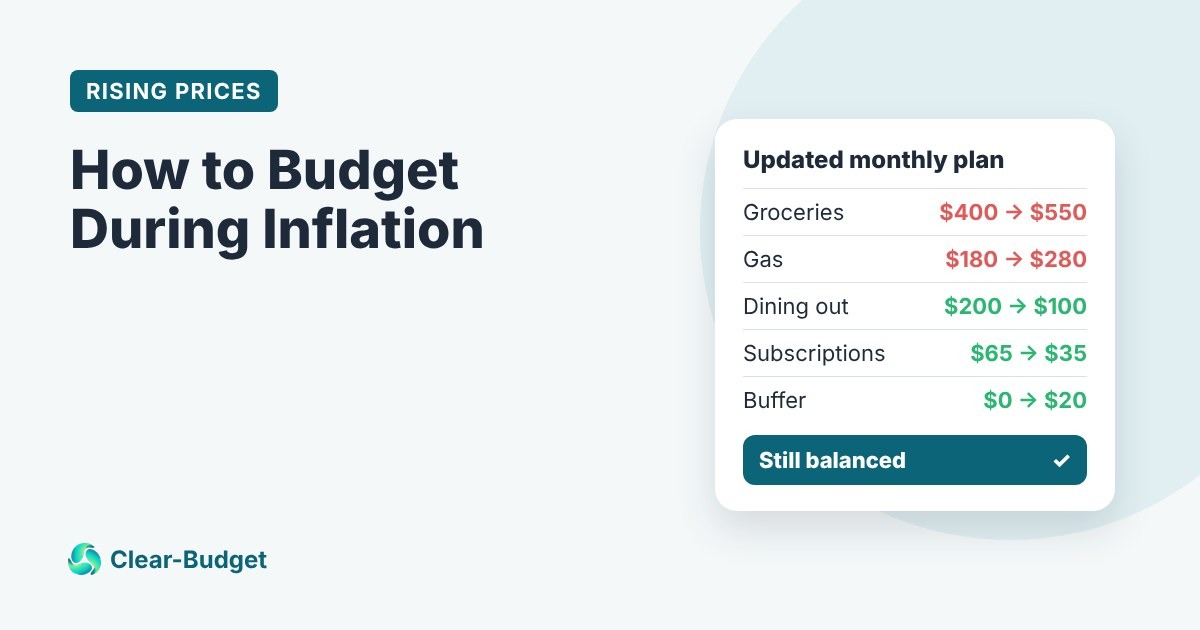
Jordan takes home $3,600 a month. After checking three months of statements, Jordan sees groceries running about $550 and gas about $280. Income hasn’t changed, so the extra $290 has to come from somewhere.
|
Category |
Old plan |
New plan |
Change |
|
Groceries |
$400 |
$550 |
+$150 |
|
Gas |
$180 |
$280 |
+$100 |
|
Electric and gas bill |
$160 |
$180 |
+$20 |
|
Buffer for price jumps |
$0 |
$20 |
+$20 |
|
Dining out |
$200 |
$100 |
−$100 |
|
Delivery apps |
$80 |
$30 |
−$50 |
|
Streaming and subscriptions |
$65 |
$35 |
−$30 |
|
Shopping |
$150 |
$90 |
−$60 |
|
Savings |
$300 |
$250 |
−$50 |
|
Net change |
|
|
$0 |
Rent ($1,250), car payment, insurance and other fixed bills stay the same and are not shown.
Jordan didn’t cut anything to zero. Savings dropped by only $50, and a $20 buffer now catches the next surprise. The plan is realistic, so Jordan will actually keep it.
Focus on flexible spending first
Some costs are hard to change quickly, like rent, insurance and loan payments. Others have more room.
(New to the difference? Here is a quick guide to fixed vs variable expenses.)
Areas worth reviewing:
• Dining out
• Streaming services
• Delivery apps
• Subscription creep
• Impulse purchases
• Convenience spending
You don’t need to get rid of these completely. Small changes can offset higher essential costs.
Inflation often leads to emotional spending
Money stress can trigger stress spending. People lean on credit cards more, buy on impulse, and “treat themselves” more often during hard stretches.
Those habits can create more long-term strain. Awareness matters, and intentional spending matters more than ever. These tips for sticking to a budget can help when stress makes it harder.
Build more cushion into your budget
Inflation makes emergency savings more important, because emergencies cost more too. Car repairs, utility bills, replacement appliances and medical bills all rise.
If you can, raise savings contributions slightly, build a little extra room into categories, and plan for future increases. Even a small buffer reduces stress.
Review your budget more often
When prices are stable, a monthly review may be enough. When they are moving, weekly reviews work better.
A quick weekly check-in helps you catch category increases early, notice spending drift, and adjust before small problems grow. Budgeting works best when it stays active.
This is where a simple tool helps. In Clear-Budget, you can raise a category in seconds, see your running balance update, and set bills to repeat monthly or every two weeks. It’s free, and it never asks for your bank login.
Long-term mindset: inflation is part of financial life
Inflation is frustrating, but it is a normal part of long-term economics. The people who handle it best are rarely the ones with perfect budgets.
They are the people who:
• Track spending consistently
• Adjust quickly
• Build savings steadily
• Stay flexible
• Avoid panic decisions
Consistency matters more than perfection. Adjusting your budget isn’t failure. It is exactly what a budget is for.
Frequently asked questions
How much should I raise my grocery budget for inflation?
Use your own numbers, not a national average. Add up the last two or three months of grocery spending and budget the average, plus a small buffer.
Should I stop saving while prices are high?
Try not to stop completely. Lower the amount if you must, as Jordan did, but keep the habit going and protect your emergency fund.
What expenses should I cut first during inflation?
Start with flexible spending: dining out, delivery, subscriptions and impulse buys. These are faster to change than rent or insurance.
How often should I review my budget when prices are rising?
Weekly is best. A 10 to 15 minute check-in lets you catch a rising category before the month is over.
This article is for general education only and is not financial advice.