A monthly budget can look fine on paper and still leave you short on the 14th. That happens because bills don’t wait for the end of the month. Rent might be due on the 1st while your second paycheck lands on the 16th.
Budgeting by paycheck fixes that. You plan each paycheck on its own and decide which bills it has to cover before the next one arrives. This guide walks through the method for every common pay schedule, with a worked example and a template you can copy.
|
Key takeaways • Plan one paycheck at a time, from payday to the day before the next payday. • Assign each bill to the last paycheck that arrives before its due date. • If one paycheck is overloaded, let the lighter paycheck set money aside for it. • Leave a small buffer in every paycheck for surprises. |
What does it mean to budget by paycheck?
A paycheck budget covers the days between two paydays, not a calendar month. Each paycheck gets its own short plan: money in, bills out, spending money, savings, and what is left.
It works especially well if you get paid every week or every two weeks. It also helps anyone who has felt that "the money is there, just not yet." If you are new to budgeting, start with our beginner’s guide to creating your first budget and come back here.
The one rule: each bill goes on the paycheck before its due date
Here is the whole method in one sentence. Pay each bill from the last paycheck that arrives before its due date.
If rent is due on the 5th and you are paid on the 2nd and the 16th, rent belongs to the paycheck on the 2nd. A phone bill due on the 20th belongs to the paycheck on the 16th. The calendar month does not matter.

Each bill goes on the last paycheck that lands before its due date.
How to budget by paycheck in 6 steps
1. List your paydays for the next two months, with the amount you actually take home.
2. List every bill with its due date and amount. Include things that come out automatically, like subscriptions.
3. Assign each bill to a paycheck using the rule above. Write the paycheck date next to the bill.
4. Add day-to-day spending for each pay period: groceries, gas, household items. Divide your usual monthly amount by the number of pay periods.
5. Add savings and debt payments. Even $25 per paycheck counts. Our emergency fund guide explains how much to aim for.
6. Check what is left. If a paycheck goes negative, move a bill, move savings to the other paycheck, or let the lighter paycheck set money aside.
Not sure which costs stay the same each month? Fixed vs variable expenses covers how to sort them.
Worked example: Maya’s two paychecks
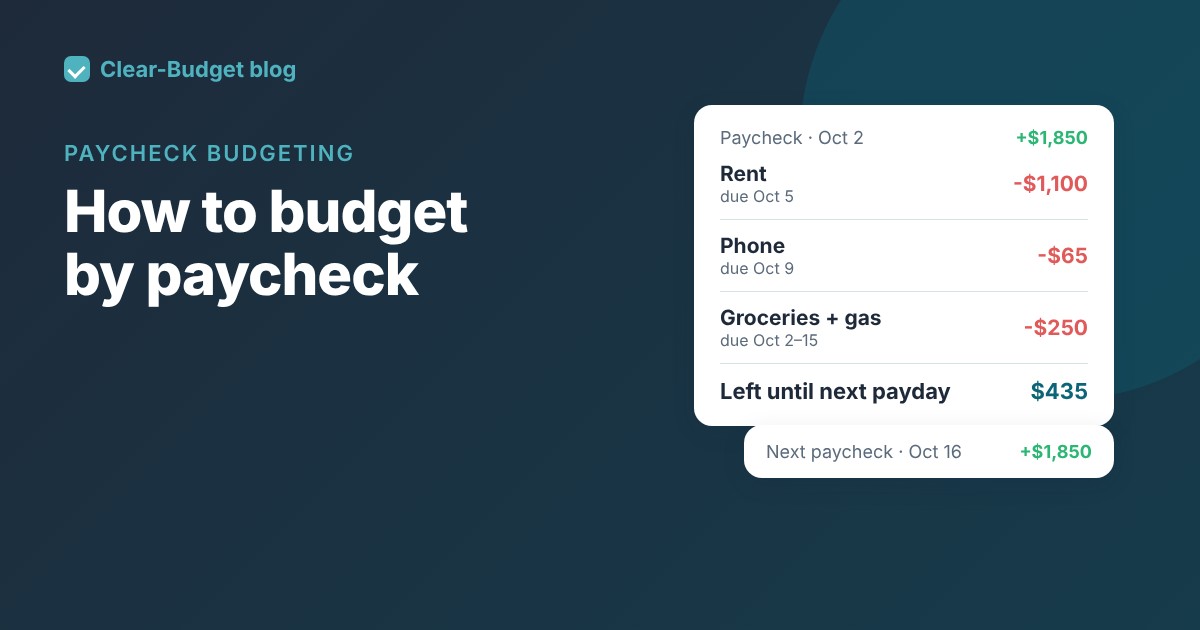
Maya takes home $1,850 every two weeks. In October she is paid on the 2nd, the 16th and the 30th. Her rent is $1,100, due on the 5th.
Using the rule, her first paycheck covers everything due from Oct 2 to Oct 15. Her second paycheck covers Oct 16 to Oct 29.
|
Paycheck A (Oct 2) |
Amount |
Paycheck B (Oct 16) |
Amount |
|
Rent (due Oct 5) |
$1,100 |
Electric (due Oct 20) |
$95 |
|
Phone (due Oct 9) |
$65 |
Internet (due Oct 22) |
$60 |
|
Car payment (due Oct 12) |
$250 |
Credit card minimum (due Oct 24) |
$75 |
|
Car insurance (due Oct 15) |
$120 |
Streaming (due Oct 28) |
$16 |
|
Groceries + gas (2 weeks) |
$250 |
Groceries + gas (2 weeks) |
$250 |
|
|
|
Fun money |
$200 |
|
|
|
Emergency savings |
$500 |
|
|
|
Extra to credit card |
$100 |
|
|
|
Rent head start for November |
$300 |
|
Total out |
$1,785 |
Total out |
$1,596 |
|
Left (buffer) |
$65 |
Left (buffer) |
$254 |
Paycheck A is heavy because rent lands on it. Paycheck B is light. That imbalance is common, and it is why so many people feel broke in the first week of the month.
Maya’s fix is the $300 "rent head start" in Paycheck B. Next month, rent only needs $800 from Paycheck A, which leaves her $365 of breathing room instead of $65.
|
Tip: Paycheck C on Oct 30 is not a bonus. It is the paycheck that pays November’s rent on Nov 5. Months with a third paycheck are only "extra" once the next month’s early bills are covered. |
How to budget by paycheck for each pay schedule
Paid weekly
Weekly pay means four or five paychecks a month. Each paycheck covers seven days, so a big bill like rent will rarely fit in one week.
Split large bills across the weeks before they are due. For $1,100 rent, set aside $275 from each of the four paychecks before it. Treat that money as already spent.
Paid every two weeks (biweekly)
You get 26 paychecks a year, so two months each year have three paydays. Budget with two paychecks per month and treat the third as a head start on the next month’s bills, then savings or debt.
We cover this schedule in more depth in budgeting on a biweekly paycheck.
Paid twice a month (semi-monthly)
Twice-a-month pay usually lands on the 15th and the last day of the month. That is 24 paychecks a year, with no "extra" months.
The paycheck on the last day of the month usually pays rent or the mortgage due on the 1st. The paycheck on the 15th takes the bills due from the 15th to the end of the month.
Paid monthly
With one paycheck, budgeting by paycheck and budgeting by month are nearly the same. The risk is running dry in week four.
Split your spending money into two halves: one for days 1 to 15 and one for day 16 onward. Pay every fixed bill on payday so the rest is clearly yours to manage.
Paycheck budget template
Copy this table into a notebook or spreadsheet. Make one block for each paycheck and fill it in on payday.
|
Item |
Due date |
Amount |
Paid ✓ |
|
Paycheck (date: ____ ) |
|
+ $ |
|
|
Rent or mortgage |
|
$ |
☐ |
|
Utilities |
|
$ |
☐ |
|
Phone / internet |
|
$ |
☐ |
|
Car payment / insurance |
|
$ |
☐ |
|
Debt payments |
|
$ |
☐ |
|
Groceries + gas (this pay period) |
|
$ |
☐ |
|
Savings |
|
$ |
☐ |
|
Fun money |
|
$ |
☐ |
|
Left until next payday |
|
$ |
|

One block per paycheck: the money in, the items it covers, and what is left.
Common problems (and quick fixes)
• One paycheck is always short. Let the lighter paycheck set money aside for the heavy one, like Maya’s rent head start.
• A due date falls on payday. Pay it from the previous paycheck. Deposits can arrive late in the day.
• A bill can’t move. Many lenders and utilities let you change a due date. A quick call can line a bill up with the paycheck that has room.
• Groceries keep running over. Divide your monthly grocery amount by the number of paychecks, not by 2. Weekly pay means four or five pieces.
• You forget what is paid. Tick each item as you pay it. How to never miss a bill has more ideas.
Try the free paycheck budget calculator
If you would rather not do the math by hand, the free paycheck budget calculator does it for you. Enter your pay and your bills, and see what each paycheck needs to cover.
When you are ready to keep it going, Clear-Budget is free and built for this method. You can set a budget to run until your next payday, give every item a due date, and watch the running balance after each one. Paychecks and bills can repeat weekly, every two weeks or monthly, and you swipe items paid as you go. There is no bank login.
FAQ
Is it better to budget monthly or by paycheck?
If you are paid weekly or every two weeks, budgeting by paycheck is usually easier. It shows whether you have enough money before each bill is due, not just by the end of the month.
What do I do with the third paycheck in a month?
First use it for bills due early next month, like rent. Whatever is left can go to savings or extra debt payments.
How much should I leave as a buffer in each paycheck?
Start with whatever you can, even $25 to $50. The goal is to absorb small surprises without touching savings.
Can I budget by paycheck if my income changes?
Yes. Plan each paycheck once you know the amount, and pay the most important bills first. Our guide to budgeting with irregular income goes deeper.
This article is for general information only and is not financial advice.