|
Key takeaways • Do your review in mid-November or early December, before the holidays get busy. • Compare what you planned with what you actually spent, category by category. • Look for patterns, not mistakes. Every gap is information for next year. • List next year's known big costs now, and set a monthly amount for each. • Pick two or three goals with a number and a date, not ten vague ones. |
Most of us only look at our money when something goes wrong. A year-end review flips that around. You look back when things are calm and use what you learn to make next year easier.
It doesn't have to be a big project. With your budgets or statements in front of you, it takes about an hour.
The best time is mid-November or early December. You have nearly a full year of data, and you're not yet in the holiday rush.
What you'll need
Gather these before you start:
• Your budgets from this year, or your bank and card statements if you didn't keep a budget.
• Balances for any debts and savings, now and at the start of the year if you can find them.
• Your calendar for next year, for known events like weddings, trips or a lease renewal.
If you didn't budget this year, that's fine. You can pull the same numbers from statements. Our guide on making a budget from your bank statement shows how.
Step 1: Compare plan vs actual by category
For each spending category, write down what you planned to spend each month and what you actually spent on average. Use January through October, or whatever months you have.
This is where the lessons are. Here's Ana's comparison.

Ana's plan vs actual. Food and gifts ran over every month; gas and shopping came in under.
|
Category |
Planned / month |
Actual average |
Difference |
|
Groceries |
$450 |
$512 |
+$62 |
|
Eating out |
$150 |
$228 |
+$78 |
|
Gas |
$180 |
$165 |
−$15 |
|
Utilities |
$160 |
$171 |
+$11 |
|
Shopping |
$120 |
$104 |
−$16 |
|
Gifts |
$50 |
$86 |
+$36 |
|
Subscriptions |
$40 |
$58 |
+$18 |
|
Net |
|
|
+$174 over |
Ana went over by $174 a month on average. That's real money, but the table also shows exactly where it went.
Step 2: Look for patterns, not mistakes
Now read the table like a detective, not a judge. Ask what each gap is telling you. Ana noticed three things:
1. Food was planned too low. Groceries and eating out together ran $140 over every month. Her plan was wishful. Next year, she'll set a realistic food total and try to shift a little from eating out to groceries.
2. Gifts aren't monthly. Some months had no gifts at all. Others had three birthdays. Gifts need a sinking fund, not a small monthly line.
3. Subscriptions crept up. A few new ones snuck in. A quick subscription check-up will fix that in an afternoon.
Don't forget the wins. Ana spent less than planned on gas and shopping. Those are habits worth keeping.
Five questions to ask yourself
If you're not sure what the numbers mean, these questions help:
1. Which category surprised me most, and why?
2. Which month was hardest, and what happened that month?
3. What did I spend on that I'm really glad about?
4. What did I spend on that I wouldn't buy again?
5. Which costs felt like emergencies but happen every year?
Write the answers down in a sentence or two each. You'll use them in Step 5, when you set next year's goals.
Step 3: Check your progress on debts and savings
Next, look at the big picture. Write down where each debt and savings goal stood at the start of the year, and where it stands now.
Ana paid off a $3,200 credit card in August. She also built her emergency fund from $0 to $1,800. Even with her food budget running over, that's a strong year. Write your wins down. They're easy to forget and they're the best fuel for next year.
If you have debt left, now's a good time to pick a payoff plan for next year. Our guide to the debt snowball vs avalanche can help you choose.
Step 4: List next year's known costs
Many "surprise" expenses aren't surprises at all. You knew they were coming; you just didn't plan for them. So go through next year month by month and write down every cost you already know about.

Ana's known costs for 2027. Seeing them on one page makes them easy to plan for.
Ana's list for next year:
|
Cost |
When |
Amount |
Set aside per month |
|
Car registration |
March |
$180 |
$15 |
|
Car insurance (twice a year) |
May and November |
$720 total |
$60 |
|
Friend's wedding (travel and gift) |
June |
$600 |
$50 |
|
Back to school |
August |
$300 |
$25 |
|
Holidays and gifts |
All year |
$1,200 |
$100 |
|
Total |
|
$3,000 |
$250 |
That's $250 a month that used to show up as "surprises". Now it's planned, and spread evenly across the year.
Ana keeps it all in one savings pot. Because the biggest costs come later in the year, $250 a month always covers what's due. By March she has $750 saved for a $180 bill. By June she has $1,500, and $1,140 has come due so far.
Step 5: Set two or three goals
With your review done, choose two or three goals for next year. Not ten. A short list is one you'll remember in June.
Make each goal specific: a number, a date, and how much a month it takes. Ana's goals:
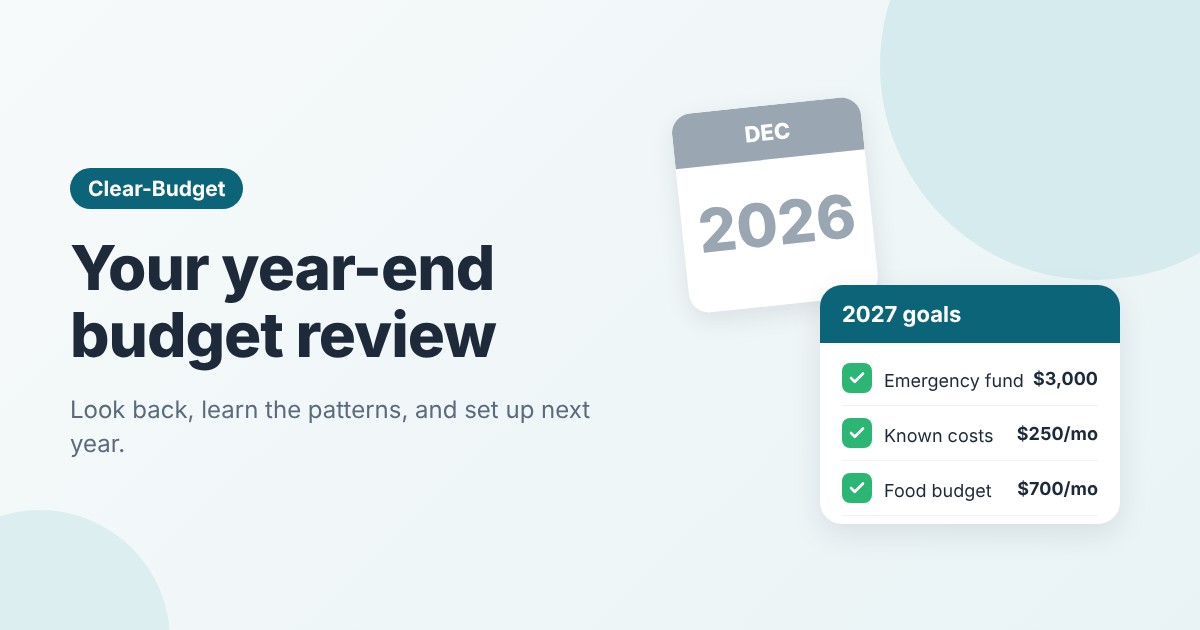
• Finish the emergency fund: $1,200 more by June. That's $200 a month for six months.
• Fund next year's known costs: $250 a month into sinking funds, starting in January.
• Set a realistic food budget: $700 a month for groceries and eating out combined, and track it weekly.
Each goal comes with a monthly number, so it fits straight into her budget. For help setting up a savings goal, see how to save for a big purchase.
Step 6: Update your budget for January
Last step: build January's budget using what you learned. Change the categories that were off. Add the new sinking fund lines. Add your goals as items you pay first, right after your bills.
The goal isn't a perfect budget. It's a more honest one than last year's. If you'd like a refresher on the basics, what is budgeting covers them.
Make it a habit
Put a reminder in your calendar for the same time next year. You can also do a quick version every three months: compare plan vs actual, check your goals, and adjust. Each review takes less time than the last.
How Clear-Budget can help
Every budget in Clear-Budget has a breakdown of income, expenses and spending by category, free. Use savings buckets to track your goals and see when you'll reach them.
With Clear-Budget Premium, Full history shows your totals and spending by category across every budget you've made, side by side. That turns Step 1 into a few minutes. Either way, you never link your bank.
FAQ
When is the best time for a year-end budget review?
Mid-November to early December works well. You have most of the year's data, and you have time to plan before January.
What if I didn't keep a budget this year?
Use your bank and card statements instead. Download the last few months and sort the spending into categories. It's a great way to start.
How many financial goals should I set?
Two or three. Each one should have a number, a date and a monthly amount. More than that, and it's hard to stay focused.
What if my review shows I overspent all year?
That's useful, not a failure. It tells you which numbers to make more realistic. A budget you can stick to beats a perfect one you can't.
This article is for general information only and is not financial advice.