|
Key takeaways • Start with a clear goal amount and a real deadline. • Goal ÷ paychecks until the deadline = what to save each payday. • Keep the money in a separate savings account, not in checking or investments. • Track it as a savings goal so you can see progress and stay on pace. |
Big purchases have a way of sneaking up on you.
The car needs new brakes, the laptop dies, or a friend's wedding is across the country.
If there is no money set aside, the cost usually lands on a credit card. Saving ahead is cheaper and a lot less stressful. Here is a simple way to do it.
Step 1: Decide exactly what you are saving for
A vague goal like "save more" is hard to stick to. A specific goal is easier, because you know when you are done.
Write down what the purchase is and what it will really cost. Get a quote, look up prices, or use last time's bill. Then add a little for tax, fees and price changes.
• Vague: "Save for the car."
• Clear: "Save $3,000 for car repairs by the end of August."
Step 2: Pick a deadline
Your deadline is when you need the money. Sometimes it is fixed, like a trip date. Sometimes you choose it, like replacing an old phone.
Be honest here. A deadline that is too short will need a payment you can't keep up. A deadline that is far away is fine, as long as the item will hold out until then.
Step 3: Do the per-paycheck math
Once you have an amount and a deadline, the rest is division.
|
The formula: (goal amount − what you already have) ÷ number of paychecks before the deadline = amount to save each payday. |
Counting paychecks, not months, matters if you are paid every two weeks. Some months have three paydays, so the count won't be exactly two per month. Grab a calendar and count the real dates.
If the number is too high, you have three levers: lower the goal, push the deadline back, or free up money elsewhere in your budget.
Worked example: Dani's $3,000 car repair fund
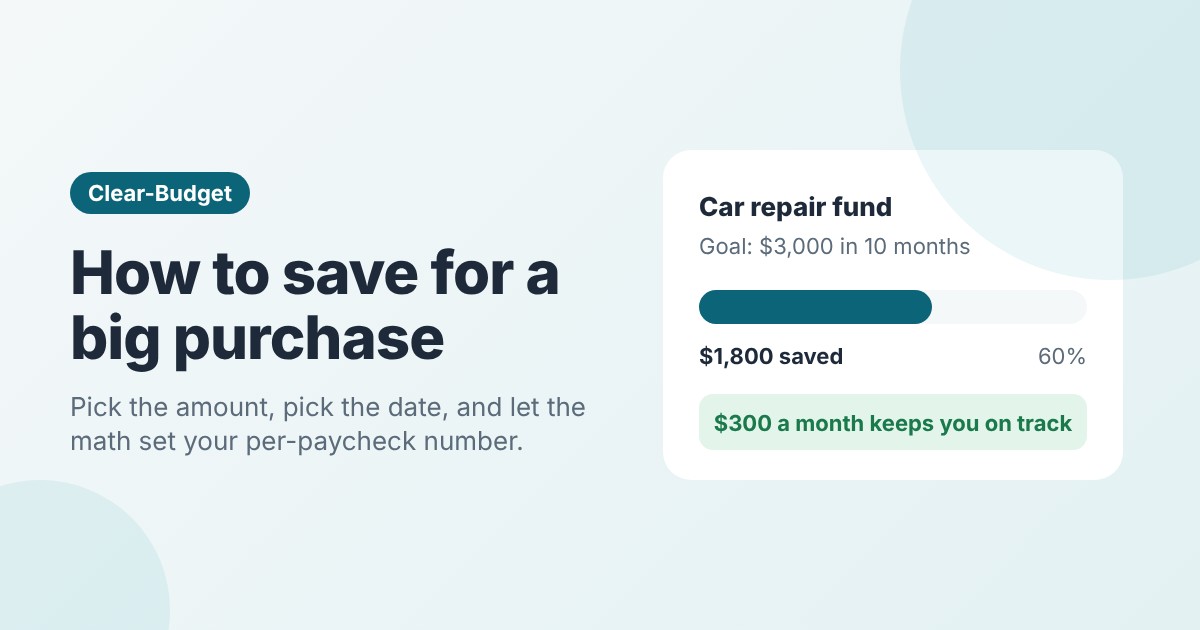
Dani's car is getting older. Her mechanic says she will likely need about $3,000 of work in the next year: tires, brakes and a timing belt. She wants the money ready in 10 months, by the end of August.
Dani is paid every two weeks. She counts 21 paydays between now and the end of August. She is starting from zero.
|
Step |
Math |
Result |
|
Goal amount |
|
$3,000 |
|
Already saved |
|
$0 |
|
Per month |
$3,000 ÷ 10 months |
$300 |
|
Per paycheck |
$3,000 ÷ 21 paychecks |
$142.86 |
|
Rounded up |
|
$143 per paycheck |
She rounds up to $143. That small extra means she will finish a few dollars ahead, which covers any price bump.

Dani's fund grows by about $300 a month and hits $3,000 in August.
What if Dani already had some saved?
Say Dani already had $400 in savings for the car. Now she only needs $2,600. That works out to $2,600 ÷ 21 = $123.81, or about $124 per paycheck.
Where does the $143 come from?
Dani looks at her budget for each paycheck. She cuts her takeout budget by $60, pauses one streaming service for $15, and moves $68 that was going to "misc." Together that is $143.
If you are not sure where your money goes now, start with how to track your spending. It usually turns up more room than you expect.
Where to keep the money
Where the money sits matters almost as much as how much you save. The right spot is safe, easy to reach when you need it, and a little out of sight until then.
|
Option |
Good for a big purchase? |
Why |
|
Checking account |
Not great |
Too easy to spend by accident |
|
Separate savings account |
Yes |
Safe, separate and easy to reach |
|
High-yield savings account |
Yes |
Same as savings, often with more interest |
|
Cash at home |
Not great |
Can be lost or stolen and earns nothing |
|
Stocks or investments |
Usually no |
Value can drop right before you need it |
For most short-term goals, a separate savings account is the simple answer. If your goal is less than a few years away, you want the money to be there on the day you need it.
Make it automatic
The best way to stay on track is to stop deciding every payday. Set the transfer once and let it run.
• Set up an automatic transfer from checking to savings on payday.
• Put it in your budget as a line item, like any other bill. It comes out before spending money, not after.
• Check in once a month. Are you on pace? If you got behind, add a little extra the next time.
This is the "pay yourself first" idea, and it is one of the habits in our list of realistic tips to stick to a budget.
Track it with a savings goal bucket
It is easier to keep going when you can see progress. In Clear-Budget, you can create a savings goal bucket for each big purchase. Give it a name and a target, like "Car repairs, $3,000."

Buckets in the Clear-Budget phone app. Savings buckets show how much is saved and when you will reach the goal.
Then add your $143 transfer to your budget as a repeating item every two weeks and link it to the bucket. Each time you mark it paid, the bucket goes up. The bucket shows your progress and the date you will reach the goal at your current pace.
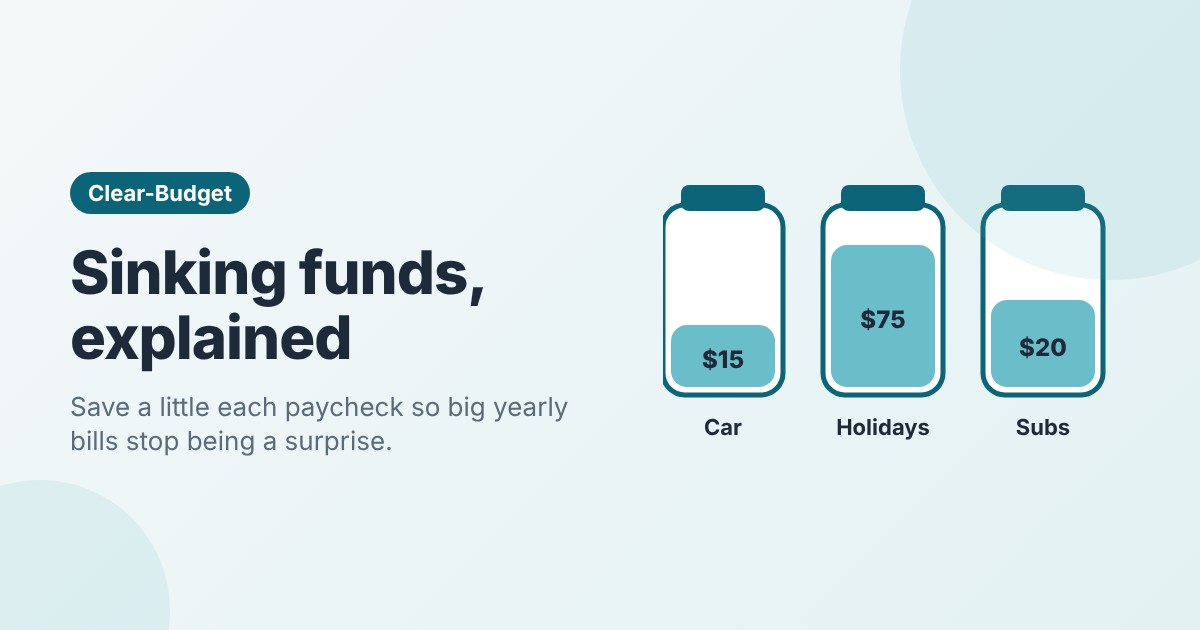
If you have more than one goal, give each one its own bucket. That way the car money never gets mixed up with the vacation money. For costs that come back every year, the same idea is called a sinking fund.
Ways to reach your goal faster
If your per-paycheck number feels too big, you don't have to just push the deadline back. Try a few of these first.
• Save windfalls. Put tax refunds, bonuses, birthday money or cash from selling old stuff straight into the goal.
• Use the third paycheck. If you are paid every two weeks, two months a year have three paydays. Send most of that extra check to your goal.
• Trim one category. Pick one area, like eating out, and cut it by a set amount until the goal is done.
• Shop around. For repairs and big items, get two or three quotes. A lower price shrinks the goal itself.
Rising prices can make this harder. Our guide on budgeting during inflation has more ideas for finding room.
Mistakes to avoid
• Saving in checking. It blends with spending money and quietly disappears.
• No deadline. Without a date, there is no per-paycheck number, and saving becomes "when I can."
• Starting too big. A plan you can keep for 10 months beats a bigger one you drop after two.
• Forgetting the extras. Taxes, delivery, setup and fees can add a surprising amount to the final bill.
What if something comes up?
Life happens. If you have to pause your savings for a paycheck or two, that is fine. Just redo the math with the new number of paydays left.
If a real emergency hits, that is what an emergency fund is for. Try to keep your purchase savings and your emergency savings apart, so one doesn't quietly eat the other.
Start your plan today
Pick one purchase. Write down the amount and the date. Count your paydays and divide.
Then create a free Clear-Budget account and add it as a savings goal. If you want to see how the savings fits with the rest of each paycheck, try our free paycheck budget calculator.
Frequently asked questions
How much should I save each paycheck for a big purchase?
Divide what you still need by the number of paydays before your deadline. For $3,000 over 21 paychecks, that is about $143 per paycheck.
Should I save or just use a credit card?
Saving first is usually cheaper. A card balance you carry costs interest. Cash you saved costs nothing extra and leaves no bill behind.
What is the best account for short-term savings?
A separate savings account is a solid choice. It keeps the money safe and apart from daily spending, and you can reach it when it is time to buy.
Can I save for more than one thing at once?
Yes. Give each goal its own amount, deadline and savings goal bucket. Start with the most urgent one if money is tight.
This article is for general education and is not financial advice. Your situation may be different, so adjust the numbers to fit your own budget.