|
Key takeaways • Pick one total for the whole season before you buy anything. • Make a gift list with a price next to every name. • Count the hidden costs: food, travel, shipping, wrapping and decorations. • Split the total across the paychecks you have left before the holidays. • Track as you buy, and move money between lines instead of adding more. |
The holidays don't sneak up on us. They are on the same dates every year. Yet many of us still pay for December well into February.
The problem is rarely one big purchase. It's dozens of small ones, spread over six weeks, with no total in sight. A holiday budget fixes that by giving the whole season one number and a plan to pay for it.
Here is how to build one in an evening.
Step 1: Pick one total for the season
Start with a single number for everything: gifts, food, travel, decorations, all of it. Don't start with the gift list. If you start with the list, the total becomes whatever the list adds up to.
To find a number that works, look at what you can set aside from each paycheck between now and the holidays. Add those amounts up. That is your honest total.
If you have a holiday sinking fund from earlier in the year, add that too. If you don't, this is a good year to start one for next year. Our guide to sinking funds shows how.
Tip: Write your total down before you open a single shopping app. A number you set when you're calm holds up better than one you set in a store.
Step 2: Count the costs people forget
Gifts get all the attention, but they are only part of the holiday bill. Before you split your total, list everything the season usually costs you:
• Food and hosting. Holiday meals, a party, bringing a dish, extra groceries when family visits.
• Travel. Gas, flights, a hotel, pet sitting while you're away.
• Cards and shipping. Stamps and shipping add up fast, especially for late packages.
• Wrapping and decorations. Paper, tape, lights, a tree.
• Extras. Tips for the people who help you all year, an ugly-sweater party, a gift exchange at work.
Look at last year's bank and card statements from November and December if you can. They will show you which of these actually happened. Our guide on how to track your spending has easy ways to do it.
Step 3: Split the total into lines
Now divide your total among those categories. Here is an example.
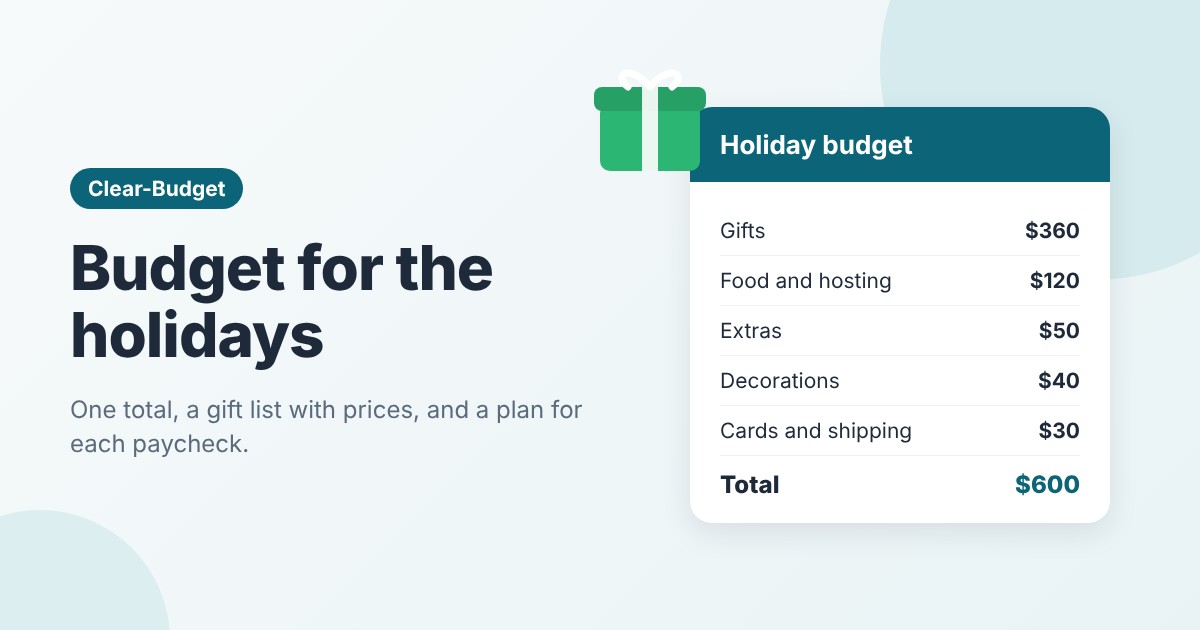
Leah is paid $1,600 every two weeks. After her bills and groceries, she can set aside $150 from each paycheck. She has four paychecks before Christmas, so her holiday total is $600.

Leah's $600 holiday budget. Gifts get the biggest share, but food and extras still take $240.
|
Category |
Amount |
Notes |
|
Gifts |
$360 |
See the gift list below |
|
Food and hosting |
$120 |
Hosting one family dinner |
|
Extras |
$50 |
Work gift swap, tips |
|
Decorations |
$40 |
Lights and a small tree |
|
Cards and shipping |
$30 |
Stamps and two packages |
|
Total |
$600 |
$150 from each of 4 paychecks |
Notice that only 60% of Leah's budget is gifts. If she had planned gifts alone, she would have run $240 over without buying a single extra present.
Step 4: Make a gift list with prices
Now turn the gift line into a list. Write every name and a price next to it. The prices must add up to the gift line, not a dollar more.
Leah's list looks like this:
• Partner: $100
• Mom: $60
• Dad: $50
• Sister: $40
• Two nephews: $35 each ($70)
• Work gift swap: $20
• Kids' teachers: $20 together
That's $360. When she finds a $75 gift for her mom, she has a choice. She can skip it, or she can take $15 from somewhere else on the list. What she doesn't do is quietly add $15 to the total.
Ways to make the gift list fit
If your list adds up to more than your gift line, try one of these before you raise the total:
• Draw names. In a big family, each person buys for one person instead of everyone.
• Set a family price limit. Many families are relieved when someone suggests it.
• Give one gift per household instead of one per person.
• Give time or skills. A home-cooked meal, babysitting, or fixing something is a real gift.
Step 5: Spread it across your paychecks
A holiday budget only works if the money exists before you spend it. So set aside your share on each payday, before anything else can use it.

Leah sets aside $150 each payday. By December 18 she has all $600.
Leah's paydays are November 6, November 20, December 4 and December 18. Each one puts $150 toward the holidays.
|
Payday |
Set aside |
Saved so far |
What she buys |
|
Nov 6 |
$150 |
$150 |
Early gifts on her list |
|
Nov 20 |
$150 |
$300 |
Food for hosting, decorations |
|
Dec 4 |
$150 |
$450 |
Remaining gifts, cards, shipping |
|
Dec 18 |
$150 |
$600 |
Gift swap, tips, last groceries |
She buys things in the order her money arrives. That keeps the holidays off her credit card. If you are paid every two weeks too, our biweekly paycheck guide explains how to plan around those dates.
What if you're starting late?
If you only have one or two paychecks left, the math is just tighter. You have three honest options: a smaller total, cutting back on non-holiday spending for a few weeks, or using savings you set aside for this. Borrowing is the option to avoid, because it turns a one-month cost into a three-month one.
Step 6: Track as you buy
Your plan only helps if you check it. Every time you buy something for the holidays, write it down and see what's left on that line.
Keep it simple. A note on your phone works. So does a budget app where each line has an amount and you mark it paid when you buy it.
When a line runs out, you move money from another line. You don't add new money. This one rule is what keeps a holiday budget from slowly growing.
Common holiday budget mistakes
These are the traps that catch most of us. Our list of common budgeting mistakes covers more.
1. Forgetting yourself. It's easy to buy one thing for you on every shopping trip. If you want to treat yourself, give it its own line.
2. Shopping without a list. Sales are designed to make you buy things you didn't plan.
3. Ignoring regular bills. January rent is still due. Never take holiday money from a bill.
4. Buying in December, paying in March. If it goes on a credit card you can't pay off in full, it costs more than the price tag.
5. Not saving receipts. Keep them for returns and for next year's plan.
How Clear-Budget can help
In Clear-Budget, you can make a budget that runs from now until your last paycheck before the holidays. Add a "Holiday fund" item to each paycheck, and add each gift as an item with its price. As you buy, swipe to mark it paid and watch the running balance.
It's free, it works on your phone and the web, and it never asks for your bank login.
Plan next year's holidays now
The cheapest holiday is the one you saved for all year. In January, divide next year's holiday total by 12 or 26 and set that aside every month or every paycheck. A $600 holiday costs $50 a month, or about $23 a paycheck if you are paid every two weeks.
That turns December from a crunch into just another month.
FAQ
How much should I spend on the holidays?
There is no right number for everyone. The right number is what you can set aside from the paychecks you have before the holidays, plus anything you saved for it. Start there, not with the gift list.
Should I use a credit card for holiday shopping?
Only if you pay it off in full when the bill arrives. If you'll carry a balance, interest makes every gift cost more. If you already have holiday debt, our debt snowball vs avalanche guide can help you plan the payoff.
What if family expects expensive gifts?
Talk early. Suggesting a name draw or a price limit in early November is much easier than in mid-December. Most people are more relieved than upset.
How do I avoid overspending on Black Friday?
Shop from your list, with your gift line in front of you. If a deal isn't on the list, it isn't a deal for you this year.
This article is for general information only and is not financial advice.