|
Key takeaways • Set your Black Friday total from your budget before the sales start. • Make a list, and write a top price next to every item. • Before buying, ask three questions: Is it on my list? Is it under my top price? Would I buy it at this price next week? • Watch for traps: countdown timers, "spend $X to get Y", store cards and buy now, pay later. • Pay with money you already have, and keep receipts for returns and price drops. |
Black Friday is on November 27 this year, with Cyber Monday right after on November 30. The emails have already started.
Black Friday can be a great time to buy things you need. It can also be a great time to spend money you didn't plan to spend, on things you didn't plan to buy. The difference is all in the planning you do before the sales start.
Here's how to shop smart and finish the weekend without regret.
Start with your budget, not the ads
The ads want you to start with the deals and figure out the money later. Do it the other way around.
Before you look at a single sale, decide how much you can spend. That number should come from your budget, not from what's on sale. If you made a holiday budget, your Black Friday money comes out of your gift line, not on top of it.
Write the number down. That's your total for the whole weekend, across every store and website.
Make a list with a top price
Next, make a list of what you actually plan to buy. Gifts, and things you've been needing to replace, like a coat or a small appliance.
Then do the step most people skip: write a top price next to each item. That's the most you'll pay. Look up the usual price now, before the sales, so you know what a real deal looks like.
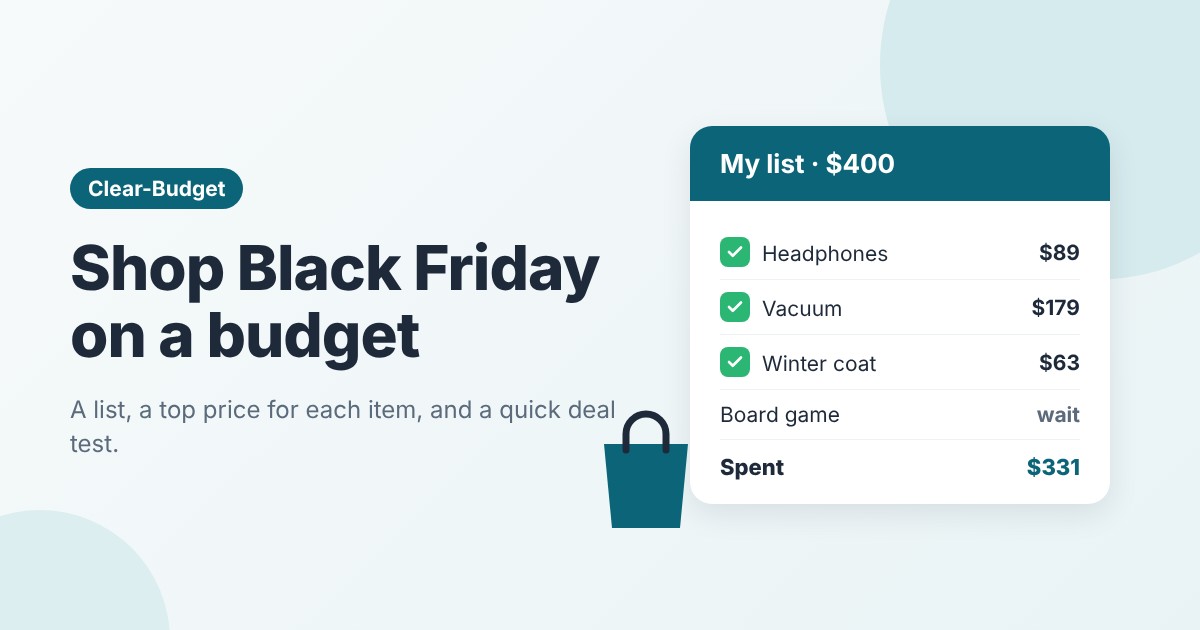
Here's Elena's list. Her budget for the weekend is $400.
|
Item |
Usual price |
Top price |
Sale price |
Decision |
|
Headphones (gift for partner) |
$130 |
$100 |
$89 |
Buy |
|
Vacuum (old one broke) |
$260 |
$195 |
$179 |
Buy |
|
Winter coat for daughter |
$90 |
$70 |
$63 |
Buy |
|
Board game for nephews |
$45 |
$35 |
$38 |
Wait |
|
Total |
$525 |
$400 |
|
$331 spent |
Elena bought three of her four items for $331. The board game was still over her top price, so she'll wait for it to drop. She also saw a big TV marked "save $200!" She skipped it. It wasn't on her list, so it wasn't a deal for her.
Use the three-question deal test
When something catches your eye, run it through three quick questions. If any answer is "no", skip it.

Three yeses means buy. Any no means skip.
1. Is it on my list? If not, it's not a saving. It's new spending.
2. Is it under my top price? You decided this when you were calm. Trust that version of you.
3. Would I buy it at this price next week? If the only reason is the countdown clock, the answer is no.
The test takes ten seconds. It's the single best way to keep a sale from turning into overspending.
Know the common deal traps
Stores are very good at making you feel like you have to buy now. Here are the tricks to look out for:
• Countdown timers and "only 2 left". They're meant to rush you. A planned purchase can wait a minute.
• "Was" prices. The crossed-out price is sometimes a price the item rarely sold for. Check the usual price yourself before the sale.
• "Spend $75, get $15 off". It only saves money if you were already spending $75. Otherwise you spend more to "save".
• Bundles. A bundle is only a deal if you wanted every item in it.
• Store credit cards. A discount today for opening a card can cost more in interest later if you carry a balance.
• Free shipping minimums. Adding a $12 item to save $6 in shipping costs you $6.
A word on buy now, pay later
Buy now, pay later lets you split a purchase into smaller payments. It can feel like a smaller price. It isn't. It's a loan, and those payments come out of future paychecks.
If you use it, add every payment to your budget on its due date, right away. If those payments would make any future paycheck tight, skip it.
What about buying for yourself?
Black Friday is a fine time to replace something you need, like Elena's vacuum. The trap is the "might as well" purchase: a second pair of boots, a gadget you'd never pay full price for.
If you want to treat yourself, give it its own line in your Black Friday total, with a top price, just like a gift. Then it's a plan, not an impulse. And if nothing on sale is worth it, keep the money. Not spending it is a perfectly good outcome.
Shop with money you already have
The best way to pay for Black Friday is with money that's already set aside. If you use a credit card for points or protection, pay it off in full when the bill arrives.
If you carry a balance, a 20% discount doesn't go far. Interest can eat up the saving quickly, and the gift ends up costing more than the full price would have. If you're already paying off cards, our guide to the debt snowball vs avalanche can help.
Keep receipts and watch for price drops
After you buy, save every receipt and order email in one folder. They're useful for three reasons:
• Returns. Holiday return windows are often longer, but check each store's policy.
• Price drops. Some stores will refund the difference if the price drops soon after you buy. It's worth asking.
• Tracking. Write down what you spent so you know what's left in your budget.
Give yourself a cooling-off rule
For anything not on your list, try a 24-hour rule. Put it in your cart and close the tab. If you still want it the next day, and it fits your budget, go ahead.
Most of the time, you'll forget about it. That's the point. Our list of common budgeting mistakes has more on impulse spending.
After the weekend: check your budget
On Monday night, add up what you spent. Compare it with your total. Did you stay under? Great. Move any money left over to the next thing on your list, or into savings.
If you went over, don't panic. Look at where the extra went, and take it from another flexible line this month, like eating out. Then use what you learned for next year.
How Clear-Budget can help
In Clear-Budget, add your Black Friday list as items in your budget, each with its top price. When you buy something, change the amount to what you paid and mark it paid. The running balance shows what's left in real time, so you always know if the next deal fits.
It's free, it works on your phone and the web, and it never needs your bank login.
FAQ
Is Black Friday really the cheapest time to buy?
For some things, prices are lower than usual. For others, the "deal" is the same price you could get at other times. That's why knowing the usual price before the sale matters more than the date.
Should I shop Black Friday or Cyber Monday?
It depends on the item and the store. Use the same list and top prices for both. If something didn't hit your top price on Friday, check again on Monday.
How much should I spend on Black Friday?
Only what's already in your budget. A good starting point is the gift and replacement items you were going to buy anyway in November and December.
What if a deal sells out before I buy?
Let it go. There will be other sales. A missed deal costs you nothing; an unplanned purchase does.
This article is for general information only and is not financial advice.