|
Key takeaways • Pick one total for the season before you make the list. Nina chose $900. • Put every holiday cost on the date you will pay it, next to rent and the other bills. • Look for your lowest balance day. Nina's first draft hit −$95 on Dec 1, because Black Friday came before rent. • Fix the date or the price, not the total. A lower price on one gift and a later date for the other took her lowest day to $60. • Keep a buffer for the people you forget, and start next year's fund before this year ends. |
Last January, Nina opened her credit card statement and saw $1,640.
Nothing on it was reckless. Two kids' gifts, her mom, her sister's family, a tree, Christmas dinner, gas to drive three hours to her mom's. It was just a season of "I'll figure it out later."
Later turned out to be June. At $300 a month and a 24% interest rate, the last payment landed six months after the tree went to the curb. The interest added $114. Christmas cost her $1,754.
This year she did it differently. This is her real plan, the night she made it, the date that almost broke it, and the fix. (Nina is an example, but every number below is one you'll recognize.)
Meet Nina and her paychecks
Nina is a single mom with two kids: Ava, 11, and Leo, 7. She is paid $1,900 every other Friday. Between now and New Year, that's four paychecks: Nov 20, Dec 4, Dec 18 and Jan 1.
Her regular bills don't stop for the holidays. Here's what was already coming out before a single gift:
|
Bill |
When |
Amount |
|
Rent |
Dec 1 and Jan 1 |
$1,150 |
|
After-school care |
Every two weeks |
$180 |
|
Groceries |
Weekly |
$130 |
|
Gas |
Weekly |
$45 |
|
Electric and heat |
Dec 10 |
$165 |
|
Car insurance |
Dec 22 |
$110 |
|
Phone |
Dec 14 |
$65 |
|
Internet |
Dec 5 |
$60 |
On Nov 20, after the kids were asleep, she opened Clear-Budget and made one budget called "Holiday season" that runs from that night's paycheck to New Year's Day. Not a month. The exact stretch she had to get through.
Step 1: Pick the number before the list
Most holiday budgets start with a gift list and end with a total. That's backwards. The list always grows to fit.
Nina started with the total. She looked at what her four paychecks had to cover and picked $900 for the whole season. Not what she wanted to spend. What fit.
She also made a "Holidays" category in the app, so every holiday cost would add up in one place in the budget breakdown.
Step 2: Put every holiday cost on a date
Then she listed everything, and gave each one the date she'd actually pay it. This is where most plans fall apart, because gifts are only part of the season.
|
Holiday cost |
Date |
Amount |
|
Thanksgiving potluck dish |
Nov 26 |
$35 |
|
Gift for Leo |
Nov 27 (Black Friday) |
$120 |
|
Gift for Ava |
Nov 27 (Black Friday) |
$120 |
|
Christmas tree |
Dec 6 |
$70 |
|
Teacher gifts (2) |
Dec 7 |
$30 |
|
Secret Santa at work |
Dec 11 |
$25 |
|
Lights night with the kids |
Dec 12 |
$40 |
|
Wrap and ship a gift to her brother |
Dec 12 |
$45 |
|
Gifts for Mom and her sister's family |
Dec 15 |
$90 |
|
Class party |
Dec 16 |
$15 |
|
Gas to drive to Mom's |
Dec 20 |
$70 |
|
Christmas dinner |
Dec 23 |
$140 |
|
Buffer for what she forgot |
Dec 24 |
$100 |
|
Total |
|
$900 |
|
Pitfall: Planning only for gifts. Only $385 of Nina's $900 is gifts. Food, gas, the tree, shipping, the school and work extras are the rest. Leave them off and the budget is over before December starts. |
Step 3: Lay it over the paychecks, and find the lowest day
Here's what she saw once everything was in. The total was fine. The timing wasn't.
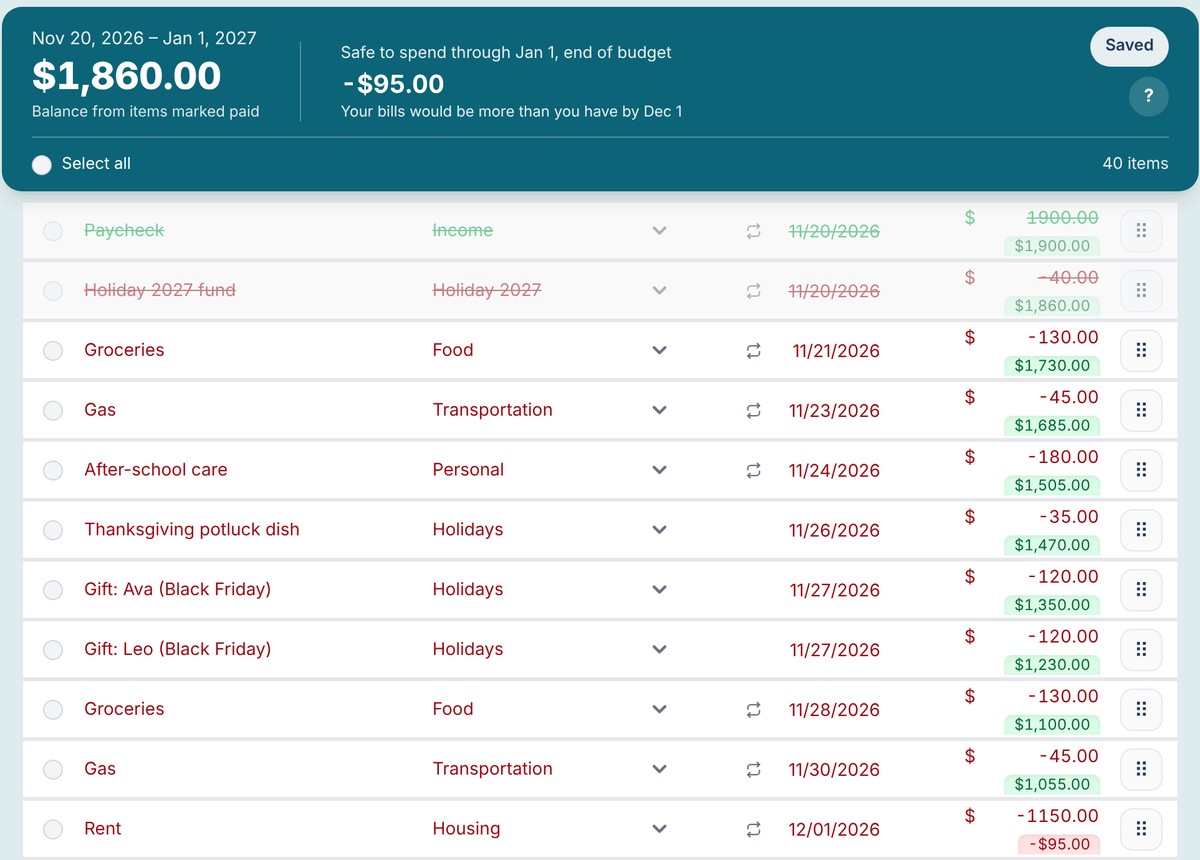
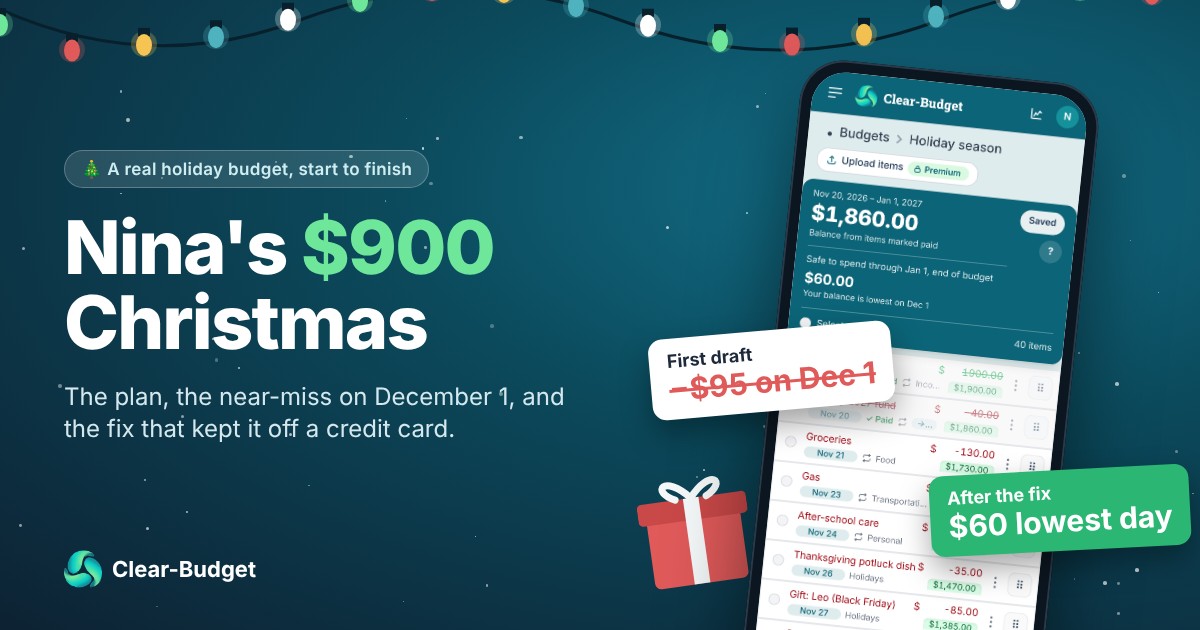
The first draft in Clear-Budget. The running balance goes to −$95 when rent comes out on Dec 1.
Both kids' gifts were set for Black Friday, Nov 27. Rent is due Dec 1. The next paycheck isn't until Dec 4. So the Nov 20 paycheck had to cover groceries, gas, after-school care, Thanksgiving, both big gifts and rent.
It couldn't. The app's header said it plainly: "Your bills would be more than you have by Dec 1." Safe to spend: −$95.
|
Pitfall: Shopping the sales before the biggest bill. Black Friday lands right before the 1st for most people. A deal that pushes rent short isn't a deal. It's an overdraft fee, or a card balance you'll pay interest on. |
Step 4: Fix the date or the price, not the total
The easy fix would have been to "just put it on the card." That's exactly how last year happened. Nina changed two things instead:
1. A price cap for Black Friday. She went in with a $120 ceiling for Leo's gift and a list, and found it for $85. The $35 she saved stays in the plan.
2. Ava's gift moved to Dec 5. It's the day after the Dec 4 paycheck. The sale price might be gone. Nina decided a few dollars was cheaper than a negative balance.
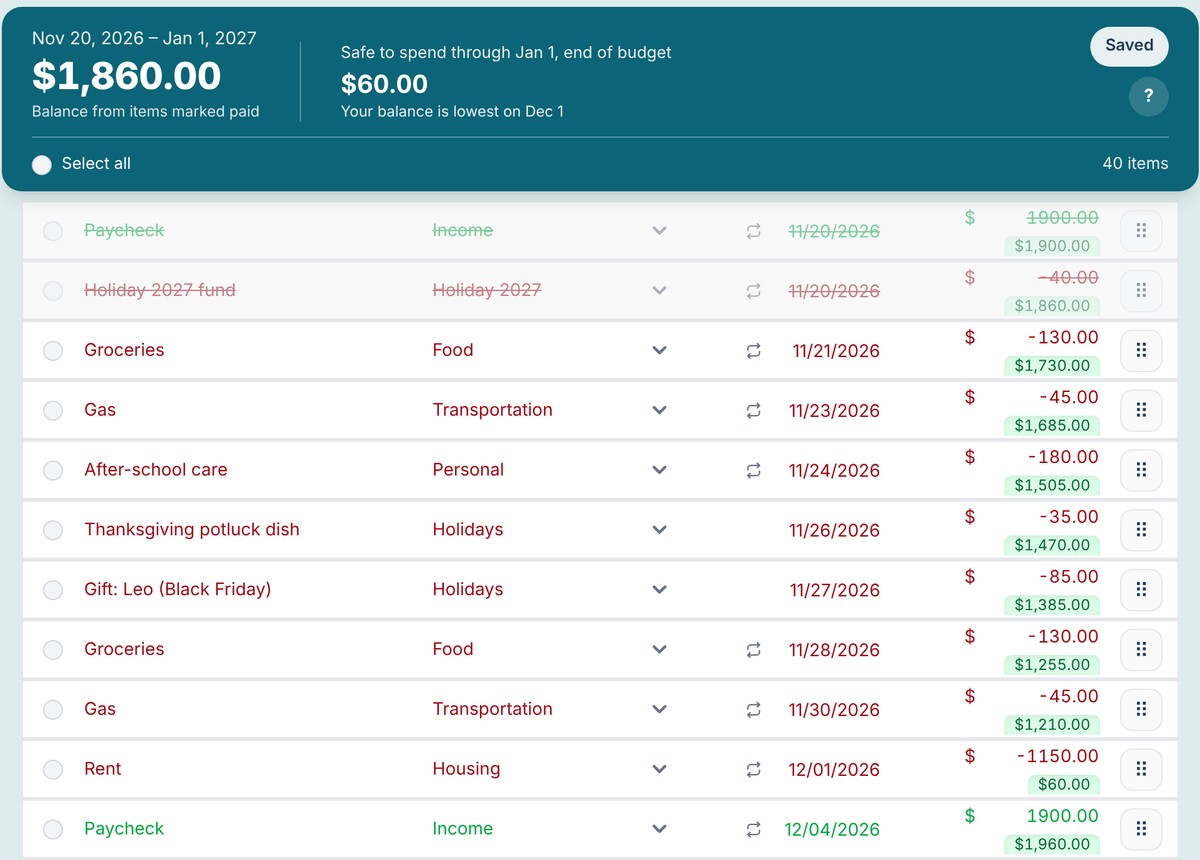
After the fix: the lowest day is still Dec 1, but now it's $60, and rent is covered.
Same season, same people, $35 less spent. The only real change was when the money left. Here's the whole six weeks side by side:
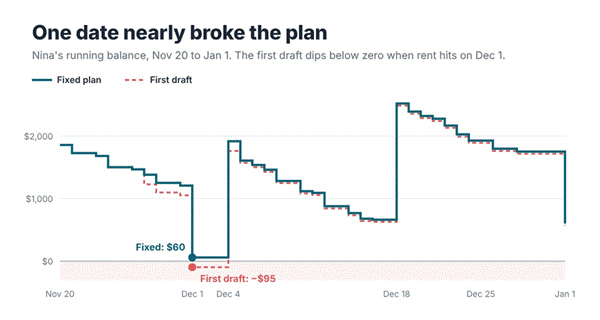
$60 is tight, and Nina knows it. That's the point. She can see it a week ahead, so there are no "quick" trips to the store on Nov 30. For more on this, read how to find your lowest balance day.
The other pitfalls Nina planned around
December bills don't take a holiday
Her electric bill is $165 in December, not the $110 she pays in the fall. Car insurance is due Dec 22. Because those bills sit in the same budget as the gifts, the running balance already counts them. Nothing "surprises" her the week of Christmas.
The people you forget
Secret Santa at work. Two teachers. A $15 class party. None of them were on her first list. That's why the $100 buffer has its own line. If it's still there on Dec 24, it becomes part of January.
The payday that falls on a holiday
Her Jan 1 paycheck lands on New Year's Day, a bank holiday, and so does January rent. Pay could come a day early or a day late. Nina checked the worst case: after January rent, her balance is still $605 without that paycheck. Rent is covered either way.
"Pay later" is still December
Pay-in-4 at checkout makes a $120 gift feel like $30. But the other three payments land in December and January, right on top of rent. If you use it, add each payment to your budget as its own item. Our guide to shopping Black Friday on a budget has a simple test for deals.
Spending without checking it off
A plan only works if it knows what already happened. Nina marks each item paid on her phone as she buys it. By Dec 12 it looks like this:
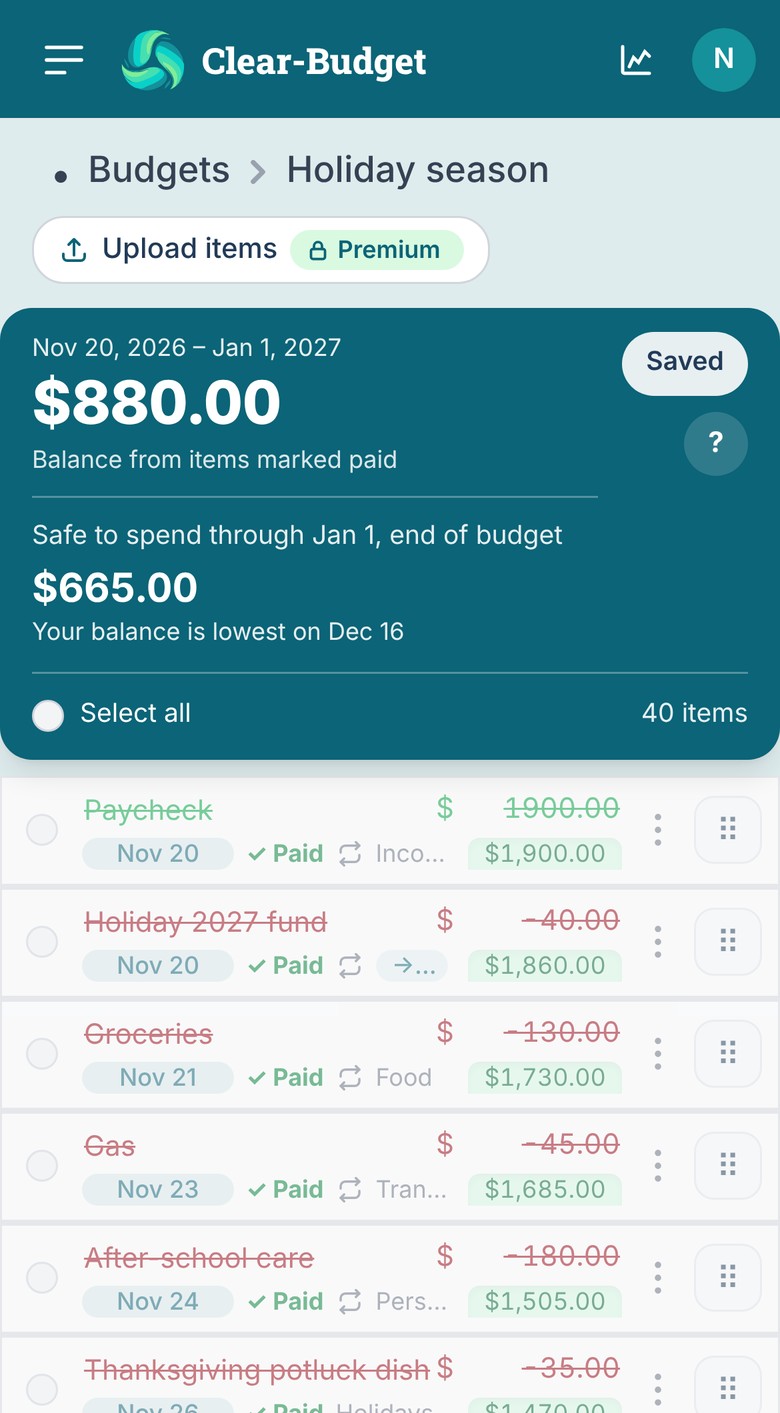
Mid December on her phone: paid items crossed off, $665 safe to spend through Jan 1, and the lowest day (Dec 16) shown before it arrives.
Step 5: Start next year's fund this year
The real reason last year hurt wasn't the spending. It was that the money had to come out of six weeks of paychecks. So Nina added one more line to every paycheck: $40 into a "Holiday 2027" savings bucket.
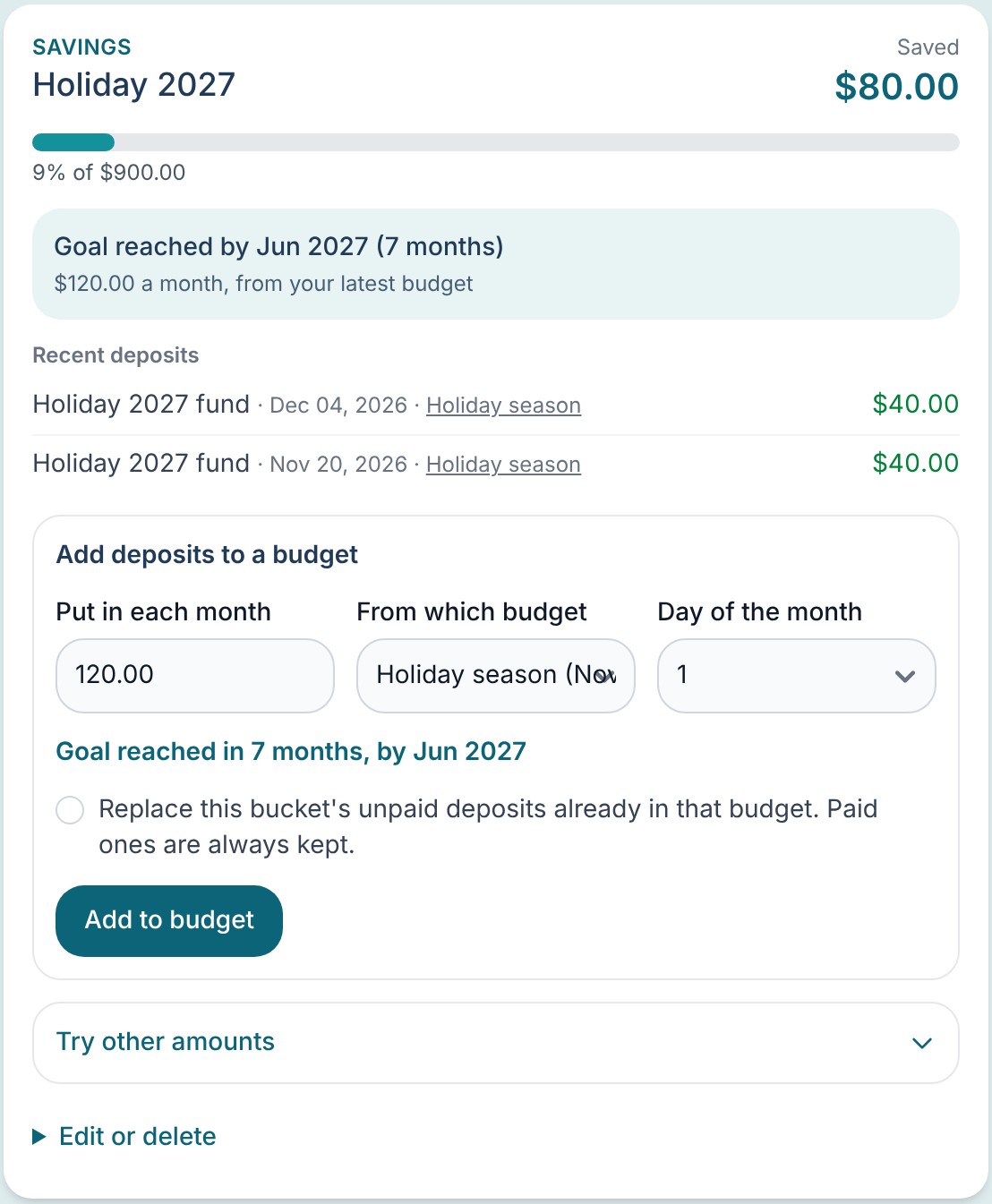
The Holiday 2027 bucket in Clear-Budget after two deposits.
$40 is easy to miss. Over 26 paychecks it's $1,040, which is more than this whole season. Next November she won't be budgeting the holidays out of four paychecks. She'll be spending money she already has. That's a sinking fund, and it's the single best fix for holiday stress.
What January looks like now
|
|
Last year |
This year |
|
Spent on the holidays |
$1,640 |
$865 planned |
|
Interest |
$114 |
$0 |
|
Card balance on Jan 1 |
$1,640 |
$0 |
|
Saved for next year |
$0 |
$120 and growing |
|
Last holiday payment |
June |
Dec 24 |
Same kids, same mom, same drive. A quieter January.
Build your own holiday budget tonight
1. Make one budget from your next paycheck to New Year's Day.
2. Add your paychecks and every regular bill with its due date.
3. Pick your holiday total, then list every cost on a date: gifts, food, travel, school, work and a buffer.
4. Check the lowest balance day. If it goes below zero, move a date or lower a price.
5. Mark things paid as you buy them, and add a small amount to next year's fund every paycheck.
You can do all of it in Clear-Budget for free, on the web or your phone, with no bank login. If you want to see what one paycheck can cover first, try the free paycheck budget calculator. For a step-by-step checklist without the story, see how to budget for the holidays, or how to budget by paycheck.
FAQ
How much should I budget for the holidays?
Start from what your paychecks can cover, not from a gift list. Add up your bills until New Year, see what's left, and pick a total that leaves a cushion. For Nina that was $900 out of four paychecks.
What holiday costs do people forget?
Food and hosting, gas or travel, shipping and wrapping, decorations, school and work events (teacher gifts, class parties, Secret Santa) and the "one more person." Give them their own lines, plus a buffer.
Should I shop Black Friday if money is tight?
Only for things already on your list, at or under the price you set, and only if your balance stays above zero through your next big bill. Check that date before you shop.
What if my payday falls on a holiday?
Ask your employer when the deposit will land, and plan for the later date. Make sure rent or any bill due that day is covered by the paycheck before it.
This article is for general education and is not financial advice.