|
Key takeaways • Buy now, pay later is a loan. Each payment comes out of a future paycheck. • Add every payment to your budget as its own item, with its due date, the moment you buy. • Count what your plans take from each paycheck, not just each purchase. • Before a new plan, check that no paycheck would drop too low. |
Today is Cyber Monday, and "split it into 4 payments" is on almost every checkout page. Klarna, Afterpay, Affirm and others make a $400 purchase feel like $100.
Buy now, pay later (often shortened to BNPL) can be handy. The trouble starts when you have two or three plans going, each with its own dates, and they all land in the same week.
This guide shows how to fit those payments into your budget so they never catch you off guard.
How pay-in-4 works
The most common plan splits a purchase into four equal payments. The first is due at checkout, and the rest come every two weeks. Some plans charge no interest if you pay on time. Others, especially longer ones, do charge interest.
Late payments can come with fees, and some lenders report to credit bureaus. Read the terms for each plan before you agree. Ours isn't a lending guide, so check with the company for the details.
The real cost: what it takes from each paycheck
A pay-in-4 plan sounds small because you think about one payment. But your budget feels every payment that lands before your next paycheck.
Tasha takes home $1,400 every two weeks. Over Thanksgiving weekend she used two pay-in-4 plans:
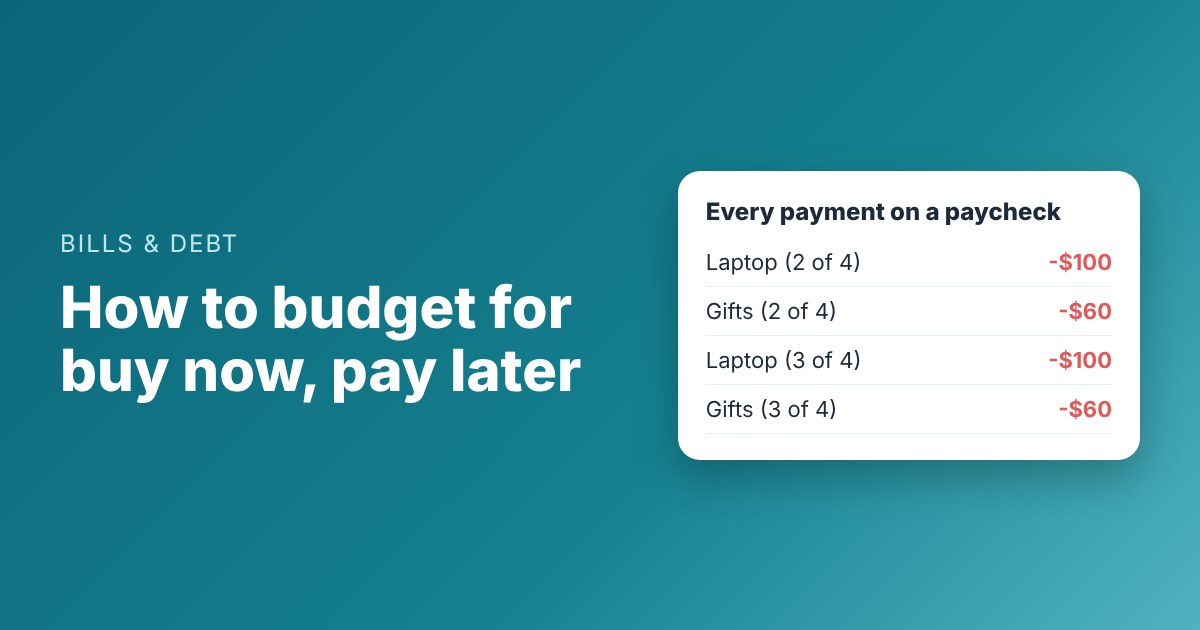
• A $400 laptop: $100 on Nov 27, Dec 11, Dec 25 and Jan 8
• $240 of gifts: $60 on Nov 25, Dec 9, Dec 23 and Jan 6

Tasha's two plans take $160 from four paychecks in a row.
Neither plan felt big at checkout. Together they take $160 out of four paychecks in a row, from November to January. That's $640 of spending spread over two months.
Step 1: Add every payment the moment you buy
Don't wait for the reminder email. As soon as you check out, add each payment to your budget as its own item:
• Name it clearly, like "Laptop pay-in-4 (2 of 4)". The number tells you how many are left.
• Use the real due date. Not the payday, the date the money leaves your account.
• Use the exact amount. Include any interest the plan charges.
Here's Tasha's December in Clear-Budget, with each payment as its own item:

Each pay-in-4 payment is a dated item. The running balance shows what's left after each one.
Step 2: Match each payment to the paycheck before it
The same rule from budgeting by paycheck applies. Each payment comes out of the last paycheck that arrives before its due date.
|
Paycheck |
BNPL payments before the next payday |
Left for everything else |
|
Dec 4: $1,400 |
$160 (Dec 9 and Dec 11) |
$1,240 |
|
Dec 18: $1,400 |
$160 (Dec 23 and Dec 25) |
$1,240 |
|
Jan 1: $1,400 |
$160 (Jan 6 and Jan 8) |
$1,240 |
Tasha's rent, groceries and bills come out of the remaining $1,240 each time.
Now Tasha can see her real number. Each paycheck has $1,240 for rent, food and bills until mid-January, not $1,400.
Step 3: Check your lowest point
The risk with BNPL isn't the total. It's a payment landing on a day when your account is already low. If an autopay fails, you may get a late fee from the lender and an overdraft fee from your bank.
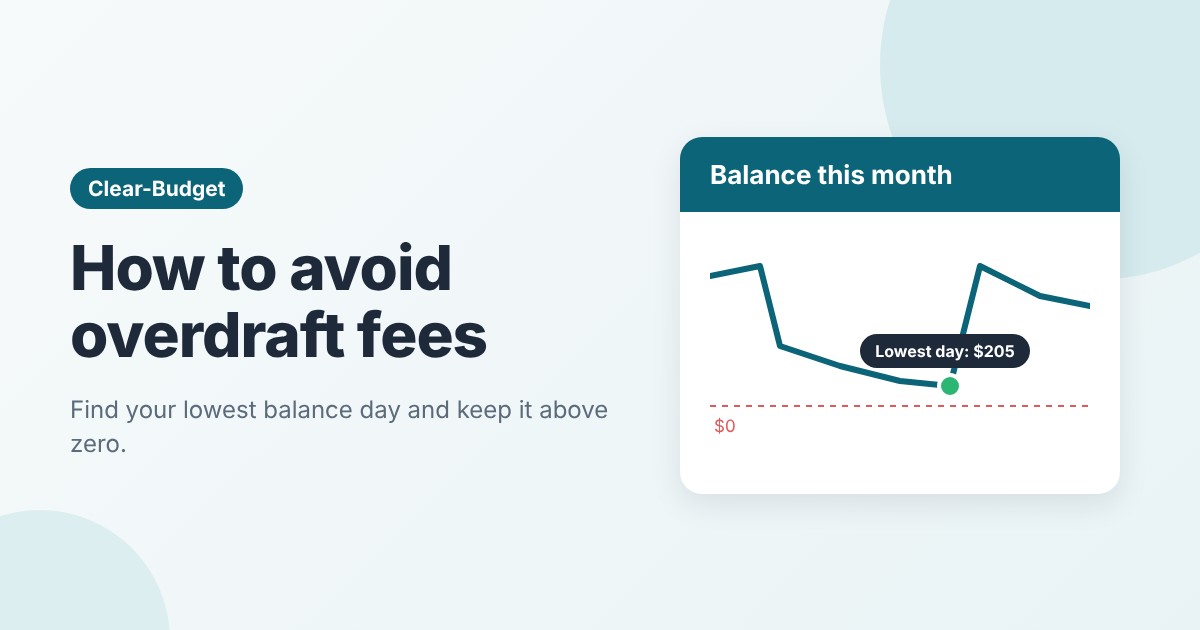
Look at your budget's lowest balance between paychecks. In Tasha's December it's $115 on Dec 14, after a gift payment, a laptop payment and her phone bill. That's tight but positive. If it went below zero, she'd need to move money or ask to change a payment date. Our guide to avoiding overdraft fees explains the lowest-balance-day idea in more detail.
Step 4: Set a limit before the next plan
Most trouble with BNPL comes from stacking. One plan is easy to track. Four overlapping plans are not.
Pick a simple rule and write it down. A few that work:
• One plan at a time. Don't start a new one until the last one is paid off.
• A per-paycheck cap. For example, no more than $100 of BNPL payments from any one paycheck.
• Only for planned purchases. If it wasn't on your list before the sale, don't split it. Our Black Friday guide has a three-question deal test.
When BNPL makes sense, and when it doesn't
|
Can make sense |
Usually a bad idea |
|
A planned purchase you could pay for today, split to smooth out cash flow |
Something you couldn't afford if you had to pay in full |
|
An interest-free plan you'll pay on time |
Plans with interest when you have savings you could use instead |
|
One plan you've added to your budget |
Several plans you're tracking from memory |
|
A needed item, like a replacement appliance |
Impulse buys during a sale |
BNPL vs a credit card
People often ask which is better. Neither is free money, and both need to be in your budget.
An interest-free pay-in-4 plan has a fixed end date, which makes it easier to plan around than a card balance that can roll on for months. A credit card you pay off in full each month can also work, and gives you one bill instead of several plans. The worst case for either is the same: buying things you couldn't afford, then paying late.
If you're already behind
If BNPL payments are squeezing your budget, don't ignore them. Missed payments can add fees and make things harder.
1. List every plan you have, with each remaining payment and date.
2. Add them all to your budget and find the tightest paycheck.
3. Cut flexible spending from that paycheck, like eating out, until the plans are done.
4. Contact the lender before a payment date if you can't make it. Ask what options they have.
5. Stop new plans until the current ones are paid off.
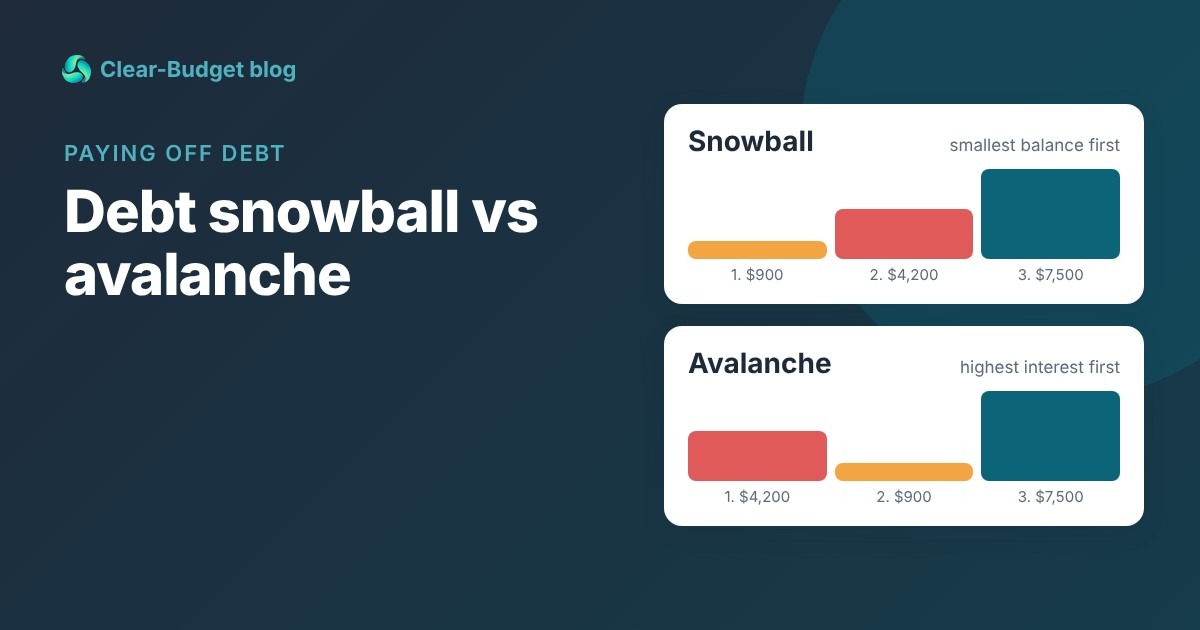
If you also carry credit card debt, see debt snowball vs avalanche for how to choose which to pay first. And if the holidays are where these plans came from, our holiday budget guide can help you plan next year's gifts in cash instead.
Keeping it simple in Clear-Budget
In Clear-Budget, add each payment as an item with its due date, and set it to repeat every two weeks for the number of payments left. The running balance shows the effect on every paycheck, and Safe to spend tells you what's free after all of them.
It's free, works on your phone and the web, and never asks for your bank login. Create a free account.
FAQ
Is buy now, pay later a good idea?
It can be for a planned purchase you could already afford, on an interest-free plan you'll pay on time. It's risky for impulse buys or when you have several plans going at once.
How do I track Klarna, Afterpay and Affirm payments in one place?
Add each payment to your budget as its own dated item, named with the store and the payment number. Then you can see every plan on one timeline.
Do BNPL payments affect my credit?
It depends on the lender and the plan. Some report payments or missed payments to credit bureaus. Check each company's terms.
Should I pay off BNPL early?
If a plan charges interest and you have the cash, paying early can save money. For interest-free plans, paying on schedule is fine as long as each payment is in your budget.
This article is for general information only and is not financial advice.