|
Key takeaways • Put both paydays on one calendar before you split any bills. • Big bills go on the larger paycheck that lands before them. Weekly costs ride on the weekly paycheck. • Keep a small shared buffer so a bill due between paydays never bounces. • Agree on who covers what in dollars, then check the timeline once a week. |
Budgeting as a couple is hard enough. It gets trickier when your paychecks arrive on different days.
Maybe one of you is paid every Friday and the other on the 15th and the last day of the month. A monthly budget adds up fine, but rent is due on the 1st and somehow there's never quite enough that week.
The fix isn't earning more. It's putting both paychecks on one timeline, so you can see which money pays which bill.
The four common pay schedules
|
Schedule |
Paychecks a year |
Example dates |
|
Weekly |
52 |
Every Friday |
|
Every two weeks (biweekly) |
26 |
Every other Friday |
|
Twice a month (semi-monthly) |
24 |
The 15th and the last day |
|
Monthly |
12 |
The 1st or the last business day |
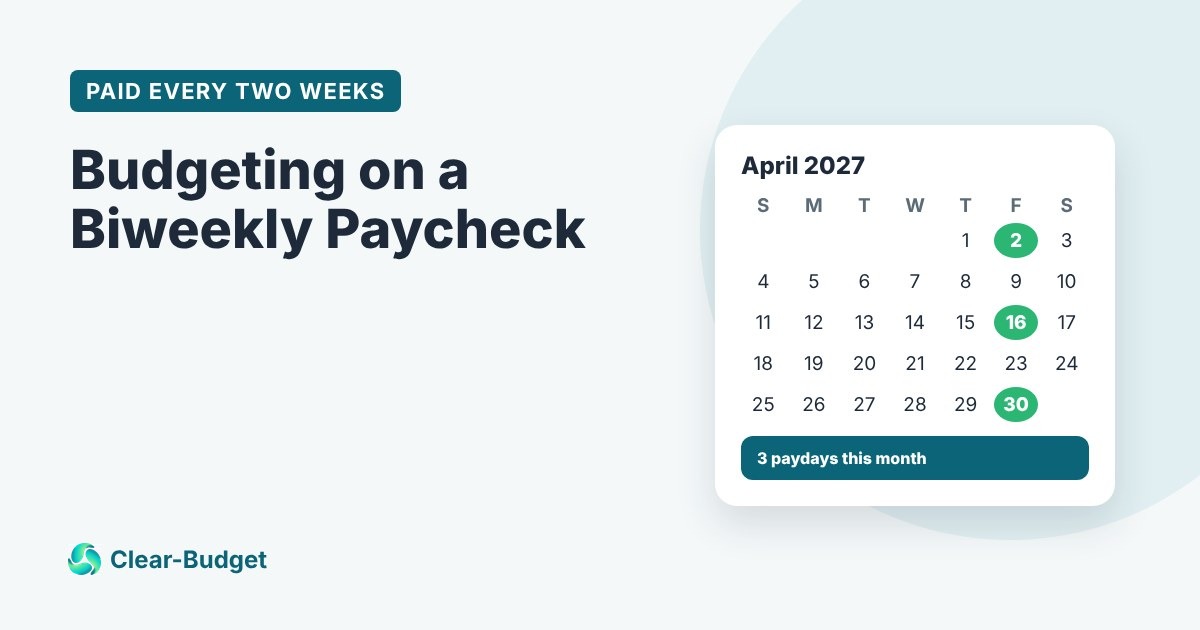
Biweekly and semi-monthly sound alike but behave differently. Biweekly pay drifts through the month; semi-monthly stays on the same dates.
Two people on different schedules means your combined income arrives in uneven chunks. Some weeks you both get paid. Some weeks nobody does.
Step 1: Put both paydays on one calendar
Start with the next 30 days. Write down every payday for both of you, with the take-home amount. Then add every shared bill with its due date.
Don't split anything yet. Just look at the order things happen in. You're looking for the gaps: bills due when no paycheck has arrived recently.
Step 2: Match each bill to the paycheck before it
The rule is the same one we use in budgeting by paycheck: each bill is paid from the last paycheck that arrives before its due date.
With two schedules, you also get to choose whose paycheck. A good default:
• Big monthly bills (rent, car payment) go on the larger paycheck that lands just before them.
• Weekly costs (groceries, gas) ride on the weekly paycheck, because it's always close by.
• Savings go on whichever paycheck has room left after bills.
Worked example: Alex and Jamie
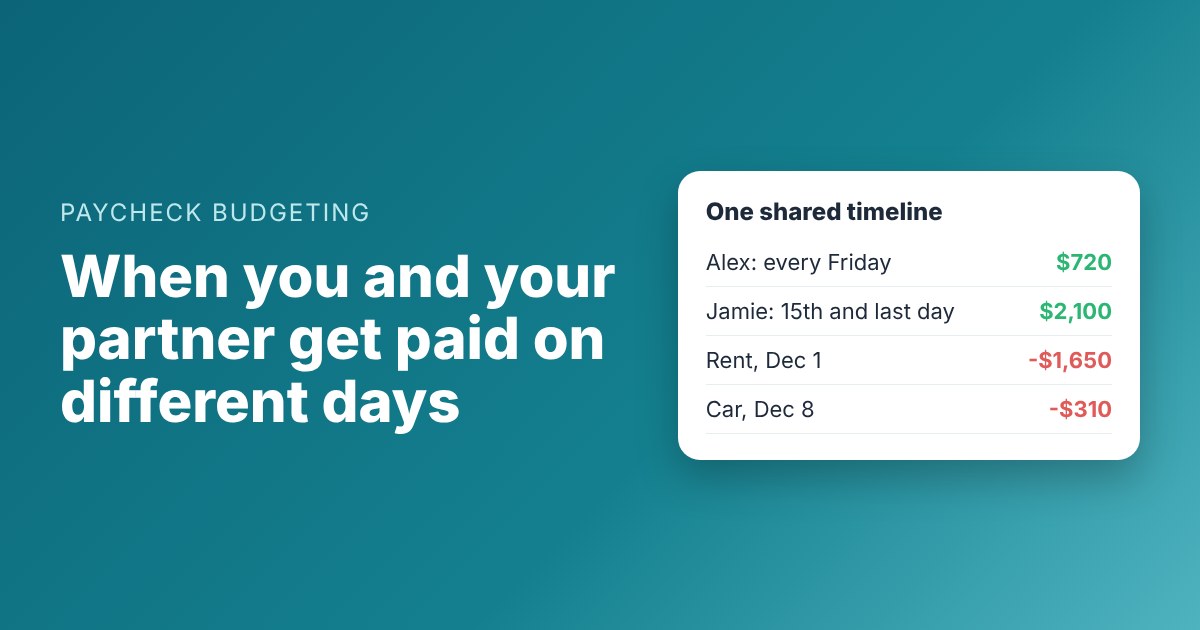
Alex is paid $720 every Friday. Jamie is paid $2,100 on the 15th and the last day of the month. Their rent is $1,650, due on the 1st.

Alex and Jamie's December, week by week.
Here's how they matched bills to paychecks:
|
Paycheck |
What it covers |
Left over |
|
Jamie, Nov 30: $2,100 |
Rent $1,650 on Dec 1 |
$450 |
|
Alex, Dec 4: $720 |
Groceries $160, car payment $310 |
$250 |
|
Alex, Dec 11: $720 |
Groceries $160, utilities $140 |
$420 |
|
Jamie, Dec 15: $2,100 |
Phones $120, then savings |
$1,980 |
|
Alex, Dec 18: $720 |
Groceries $160, savings $300 |
$260 |
Rent sits right after Jamie's paycheck. Groceries ride on Alex's every week.
Their tightest point is Dec 8, after the car payment, with $700 left. That's fine. But before they did this, the car payment was due on the 2nd, right after rent, and the account kept dipping close to zero.
They asked the lender to move the due date to the 8th, after Alex's Friday paycheck. One phone call fixed the tight week. Our guide to never missing a bill covers how to ask.
Step 3: Decide how to split
Once you know which paycheck pays each bill, splitting is easier to talk about. Three common ways:
• By paycheck timing. Each person covers the bills that land after their payday, like Alex and Jamie. Simple, but it may not feel fair if incomes differ a lot.
• By income share. Each person contributes the same percentage of take-home pay to shared bills. Our couples budgeting guide shows the math.
• Everything into one account. Both paychecks go into a joint account and the timeline does the rest.
Alex earns about $3,120 a month and Jamie $4,200. Splitting by income, Alex covers about 43% of shared costs and Jamie about 57%. They checked their timeline split against that and it came out close, so they kept it.
Step 4: Keep a small shared buffer
Even with a good plan, a bill can move or a paycheck can come a day late. A buffer covers that gap.
Start with one week of shared bills, held in the account you pay bills from. For Alex and Jamie that's about $500. Once it's there, a late paycheck is an annoyance, not an overdraft. If overdrafts have been a problem, see how to find your lowest balance day.
Step 5: Check the timeline together once a week
Ten minutes on Sunday is enough. Look at the coming week:
1. Which paychecks land this week?
2. Which bills are due?
3. What's the lowest the balance will get?
4. Is anything new, like a gift or a repair?
This works best when you both can see and edit the same budget. Otherwise one person ends up as the "money manager," and the other is always a step behind.
Plan for the odd months
Different schedules create odd months. A weekly paycheck lands five times in some months instead of four. A biweekly paycheck lands three times in two months of most years. A twice-a-month paycheck never changes.
In 2027, for example, Fridays fall five times in January, April, July, October and December. In those months Alex gets an extra $720.
Decide now what extra paychecks are for, so the money doesn't disappear. Alex and Jamie send the fifth Friday to their emergency fund. Our emergency fund guide has ideas for how much to aim for.
Doing this in Clear-Budget
In Clear-Budget, you add both paychecks to one budget and set each to repeat on its own schedule: weekly for Alex, on set dates for Jamie. Bills go in with their due dates, and the running balance shows exactly where you stand after each one.

Alex and Jamie's shared budget in Clear-Budget, with both pay schedules on one timeline.
The Safe to spend number at the top tells you what's free to spend through the end of the budget, and it names your lowest-balance day.
Shared budgets are part of Clear-Budget Premium. One of you shares the budget by email, and the other can see and edit it on the website or in the phone app without needing Premium. Planning both paychecks in one budget works on the free plan too. Create a free account to try it.
Common problems and fixes
|
Problem |
Fix |
|
Rent is due before the bigger paycheck |
Ask to move the due date, or set aside part of each weekly paycheck for rent |
|
Months with an extra paycheck feel random |
Plan them in advance and send the extra to savings. See biweekly budgeting |
|
One partner pays more and resents it |
Switch to an income-share split and write down the numbers |
|
Nobody knows the balance |
Use one shared budget both of you can open |
FAQ
Who should pay rent if we're paid on different days?
Usually whoever's paycheck lands just before the due date, as long as the overall split feels fair. You can balance it out with other bills.
Should couples with different pay schedules have a joint account?
It helps. A joint account for shared bills lets both paychecks feed one place, and the timeline shows when there's enough in it.
How do we budget a weekly paycheck and a monthly one together?
List both on one calendar. Big monthly bills go after the monthly paycheck. Weekly costs come out of the weekly paycheck.
What if one of us has irregular income?
Plan with the lower, steady amount and treat extra as a bonus. Our guide to budgeting with irregular income walks through it.
This article is for general information only and is not financial advice.