|
Key takeaways • The board is well organized: every bill, its amount and its due date. That habit is worth keeping. • Weekly pay is 52 paychecks, not 48. At $700 a week that is $3,033 a month, not $2,800. • The plan says $1,310 a month. Real months ran $1,400 to $5,200, and the first half of the year saved about $1,200, not $8,940. • The fix is an annual bills fund: $100 a paycheck for the costs that don't come every month. • Built that way in Clear-Budget, January 2027 never drops below $407, the homeowners bill is on a date, and yearly spending lands near $21,600, under the $25K goal. |
A few months ago, someone on Reddit's r/Money posted a photo of a whiteboard and a simple request: "I Love Budgeting. Rate My Budget!!"
We'll call them Cole (not their real name). Cole owns their home outright, takes home $700 a week (about $50,000 a year before tax), and puts nearly everything on a credit card that they pay in full every month.
I liked this board the moment I saw it. So I did what Cole asked. I checked every number, gave it a score, and then built the fixed version in Clear-Budget so you can copy it.
What's on the board
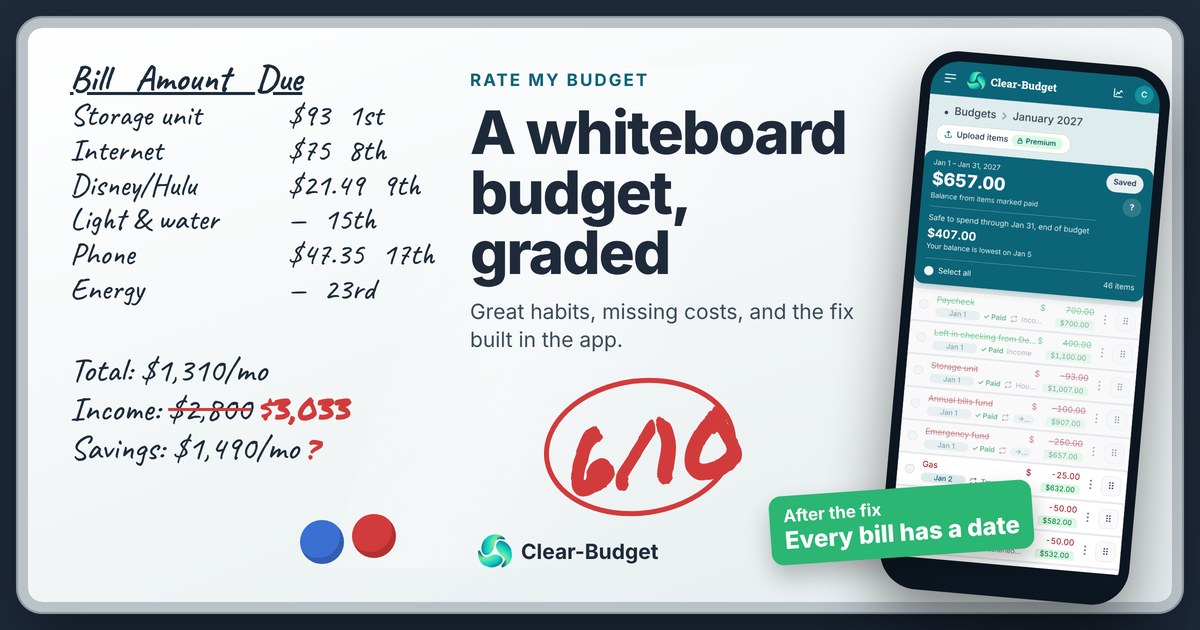
Here is the whiteboard, typed out. Blank amounts are blank on the board too.
|
Bill |
Amount |
Due |
|
Storage unit |
$93 |
1st |
|
Internet (Allo) |
$75 |
8th |
|
Disney+/Hulu |
$21.49 |
9th |
|
Light and water |
blank |
15th |
|
Phone (Straight Talk) |
$47.35 |
17th |
|
Credit cards |
blank |
21st |
|
Energy (NorthWestern) |
blank |
23rd |
Below that: car insurance twice a year ($77.87, "Oct?"), and three annual bills: homeowners insurance (January 2027, no amount), Robinhood Gold ($50, Oct 25) and YouTube Premium ($160, Sep 1). Monthly estimates: gas $100, groceries $250, fast food $300, pet supplies $50, pool league $60. Utilities are estimated at $200 a month in total.
The bottom of the board has the totals: Monthly $1,196. Total $1,310. Income $2,800. Savings $1,490. Then a goal, yearly spending under $25K, with $17K spent as of June, and spending by month: January $4.7K, February $5.2K, March $1.4K, April $2.2K, May $2.1K.
The rating: 6/10
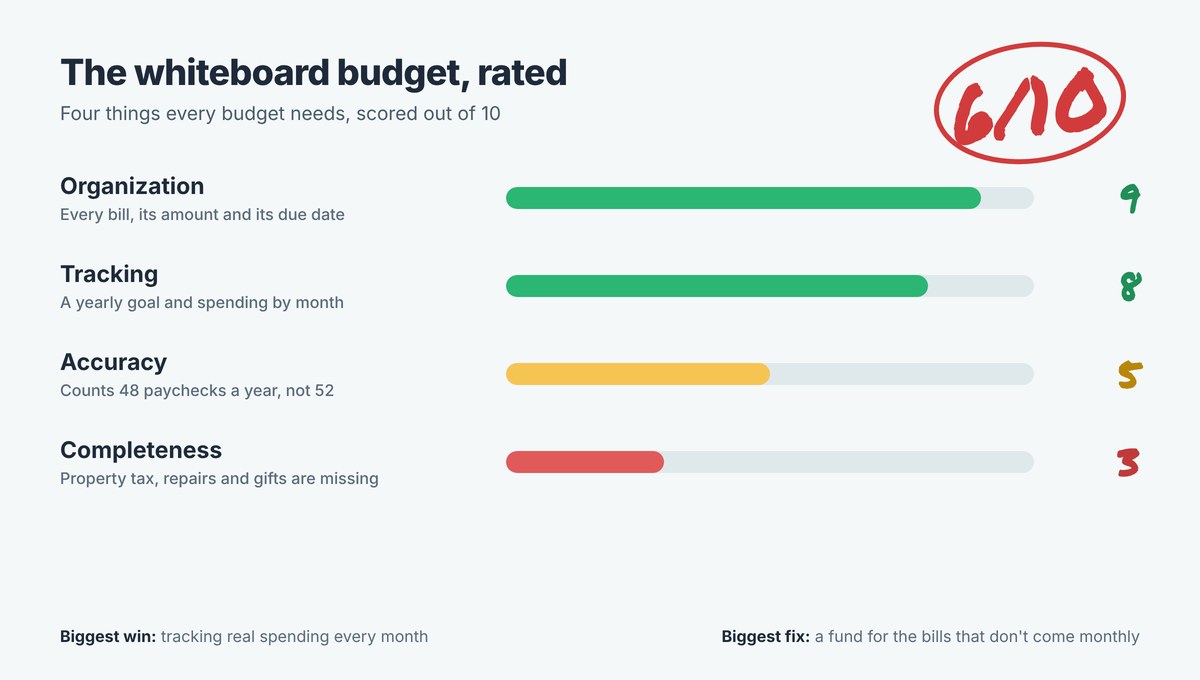
Four things every budget needs. Great habits, but the numbers don't match real life yet.
What it gets right (and why it matters)
• Every bill has a due date. Most budgets are a list of amounts. Dates are what tell you whether a paycheck can cover a bill.
• Annual bills are written down. Most people forget these until the charge shows up.
• A yearly goal, with a scoreboard. Spending under $25K, checked every month. This is the best thing on the board.
• Cards paid in full. No interest, and every purchase is in one place to track.
Where it loses points
The board is honest about spending. The plan just doesn't agree with it yet. Here are the four problems, starting with the biggest.
Problem 1: The plan and the real months don't match
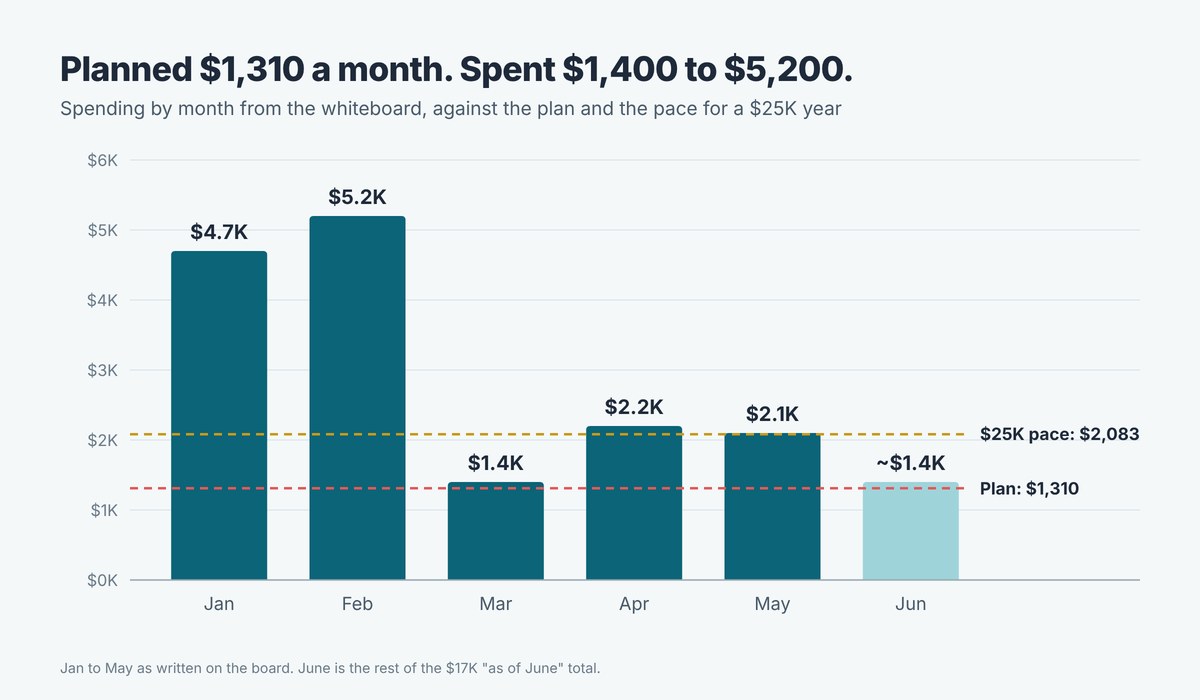
Only March came close to the $1,310 plan. January and February were more than three times it.
The plan says $1,310 a month. The board's own tracking says January was $4,700 and February $5,200. Even the calm months, April and May, were about $800 over plan.
Now the savings line. From January through June there were 26 Fridays, so 26 paychecks: $18,200 take-home. Spending was $17,000. That leaves about $1,200 saved in six months. The board says $1,490 a month, or $8,940.
The goal is at risk too. $17K spent by June leaves $8,000 for six months, or $1,333 a month. That's right at the plan, which only March has hit. At the spring pace of about $1,900 a month, the year ends near $28,400.
|
Pitfall: A budget that only lists the regular bills. The costs that sink a year are the ones that don't come monthly. We don't know what January and February were. A holiday card bill, insurance, property tax and car repairs are the usual suspects, and none of them are on the board with an amount. |
Problem 2: Weekly pay is 52 paychecks, not 48
$2,800 a month is $700 times four. But a year has 52 Fridays, not 48. The real monthly income is $700 × 52 ÷ 12 = $3,033. The board is missing four paychecks, $2,800 a year.
That's good news. It's also a planning trick. If payday is every Friday, 2027 has 53 of them, and five months get a fifth paycheck: January, April, July, October and December. Plan the month on four paychecks and give the fifth one a job before it lands.
Problem 3: Blanks and a mystery $114
The listed bills plus $200 for utilities and the monthly estimates add up to $1,196.84, which matches the board. But "Total $1,310" adds about $114 we couldn't trace. The known annual bills only come to about $30 a month.
Two quick fixes:
• Put a number on every blank. Split the $200 for utilities between the water bill and the energy bill. Call the insurer for the homeowners amount before January.
• Don't budget the credit card as a bill. The card payment on the 21st pays for everything else on the board. Give it an amount and you count your spending twice. Leave it as a reminder, and check the statement against the plan.
Problem 4: What's missing
Owning a home outright is a huge win. It also means no lender is collecting property tax and insurance for you. Those are on you now, and so are repairs. Here's what we'd add, with example amounts where the board has none:
|
Cost |
Per year |
Note |
|
YouTube Premium |
$160 |
From the board |
|
Robinhood Gold |
$50 |
From the board |
|
Car insurance (twice a year) |
$156 |
From the board |
|
Homeowners insurance |
$1,300 |
Example. Check the real quote |
|
Property tax |
$2,000 |
Example. Check the county bill |
|
Home repairs |
$600 |
Example |
|
Car maintenance |
$600 |
Example |
|
Vet |
$300 |
Example |
|
Holidays and gifts |
$600 |
Example |
|
Total |
$5,166 |
About $100 a paycheck |
That's the job for an annual bills fund: $100 every payday into a separate savings bucket, then pay these bills from it when they arrive. It's a sinking fund, and it's what turns a $5,200 February into a normal month.
The fix, built in Clear-Budget
Here is January 2027 built the new way. January is the right month to start: it has five paychecks, the homeowners bill is due, and it was the most expensive month of 2026.
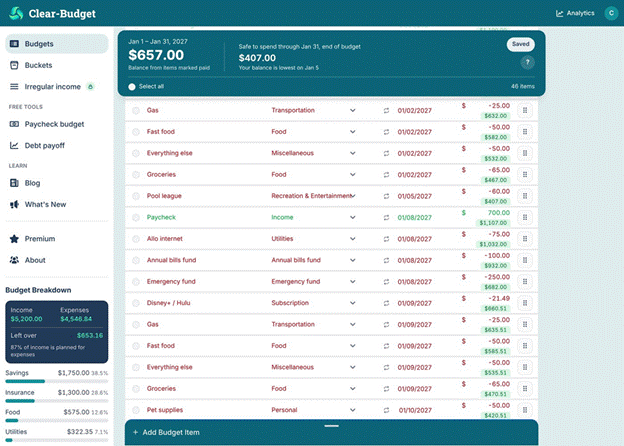
January 2027 in Clear-Budget, with Jan 1 marked paid. $407 is safe to spend through the end of the month, and the lowest day is Jan 5.
What changed from the whiteboard:
1. Five $700 paychecks on their real Fridays, and $400 left in checking from December.
2. Every bill on its due date, with the blanks filled in: light and water $90, energy $110.
3. Weekly lines instead of monthly guesses: groceries $65, fast food $50 (down from about $69), gas $25 and $50 for "everything else", the line that catches what used to blow the plan.
4. $100 every payday into an Annual bills fund and $250 into an Emergency fund, both as savings buckets.
5. The homeowners bill on Jan 20, with an example amount of $1,300.
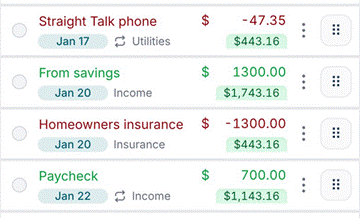
The annual bills fund starts this month, so this one time the homeowners bill comes from savings. Next January the fund pays it.
The month never goes below $407 and ends $253 ahead, which is the fifth paycheck doing its job. On a phone, the same plan shows what's paid and what's next.
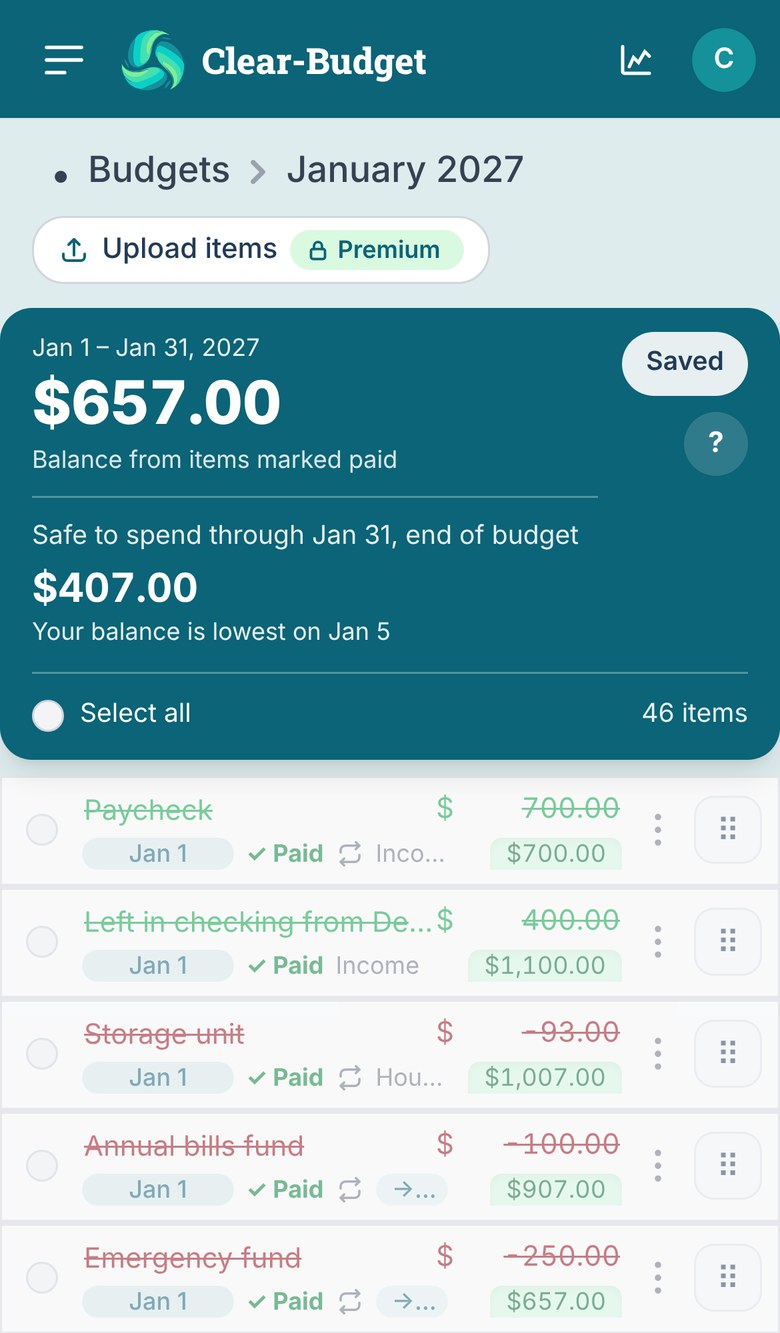
The same budget on a phone, with Jan 1 marked paid.
What the year looks like now
|
|
The whiteboard |
The fixed plan |
|
Take-home income |
$33,600 (48 paychecks) |
$36,400 (52 paychecks) |
|
Planned spending |
$15,720 |
$21,640 |
|
Irregular bills planned for |
About $30 a month |
$100 a paycheck |
|
Saved, plan |
$17,880 |
About $14,760 |
|
Saved, first half of 2026 (real) |
About $1,200 |
|
|
Under the $25K goal? |
Only if no surprises |
Yes, with $3,360 to spare |
The fixed plan saves less on paper than the whiteboard. That's the point. It plans for the bills that actually come, so the savings number is one that can really happen.
Advice for the goal: under $25K a year
1. Keep the scoreboard. Monthly tracking against a yearly goal is the best habit on the board. Add one line: planned versus actual.
2. Fund the irregular bills every payday. Start the annual bills fund now, so the January bill is covered next year.
3. Give the fifth paychecks a job. Five months in 2027 have one. Send them to the emergency fund or a retirement account.
4. Look hard at fast food and storage. Fast food at $300 is more than groceries. Cutting it to $50 a week saves about $1,000 a year. The storage unit is $1,116 a year. Is what's in it worth that much?
5. Give savings a name. An emergency fund first (three to six months of spending is a common target), then retirement. Savings with a job are much harder to spend.
If you track subscriptions like Disney+, YouTube Premium and Robinhood Gold, this is also a good time to check for ones you no longer use, or do a quick year-end budget review.
Build your own (or import this one)
You can rebuild this budget in Clear-Budget for free, on the web or your phone, with no bank login. Add your paychecks on their dates, every bill on its due date, and a savings bucket for the annual bills. If you're paid weekly or every two weeks, see how to budget by paycheck. For a full holiday plan, see Nina's $900 Christmas.
FAQ
How do I rate my own budget?
Ask four questions. Does every bill have a date? Do you track what you really spend? Does income match your real number of paychecks? Are the bills that don't come monthly planned for? A no on the last one is the most common gap.
How much is $700 a week per month?
$700 × 52 ÷ 12 = $3,033 a month. Multiplying by four gives $2,800 and leaves out four paychecks a year.
Should I put the credit card payment in my budget?
If you pay the card in full, budget the things you buy with it, not the payment. Adding both counts the same money twice.
What is an annual bills fund?
A savings bucket you add to every paycheck for costs that come once or twice a year, like insurance, property tax and repairs. When the bill arrives, the money is already there.
Based on a public post, with the poster not named. Example amounts are marked. This article is for general education and is not financial advice.